
Compare Aesthetician-Recommended Facial Sunscreens by SPF, Safety and Skin Tone
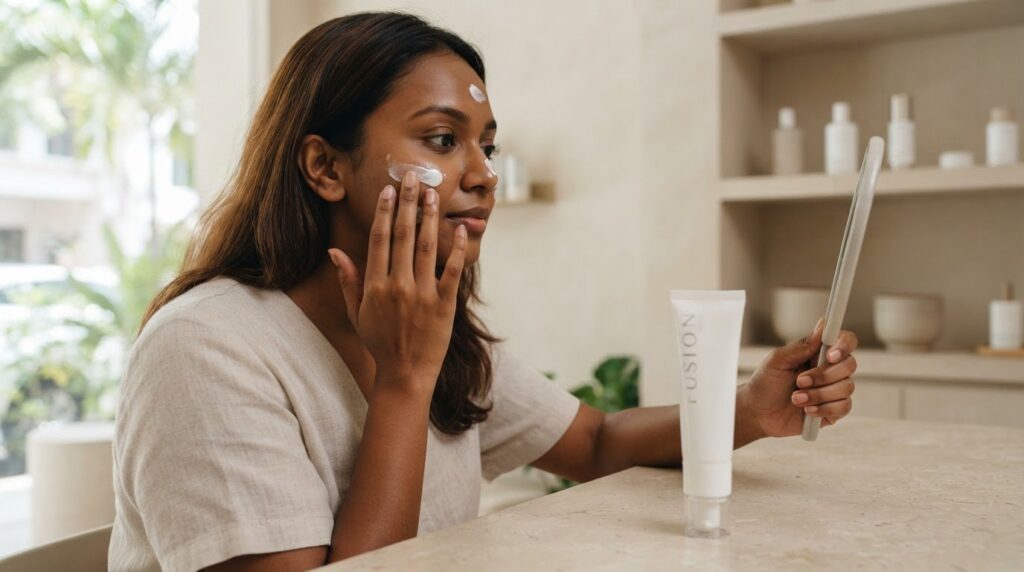
The best sunscreen recommended by aestheticians isn’t automatically the one with the highest SPF or the most familiar label. A chemical filter isn’t, by itself, a reason to rule out a facial sunscreen; what matters is choosing broad-spectrum protection that suits your skin and the way you spend time outdoors. The American Academy of Dermatology recommends broad-spectrum sunscreen with SPF 30 or higher.
It’s understandable to have questions about sunscreen safety, especially when ingredient lists and labels can be difficult to compare. SPF describes protection against UVB, while a broad-spectrum claim also indicates UVA protection. A formula that leaves a visible white cast or feels uncomfortable may be harder to use consistently.
This guide compares facial sunscreens by SPF, ingredients, size and water-resistance wording, including how their finishes may look across different skin tones. You’ll also learn how to read protection claims and weigh practical trade-offs for Singapore’s outdoor climate. The goal is to make your next sunscreen choice clearer and easier to maintain.
Key Takeaways
- According to the American Academy of Dermatology, choose broad-spectrum sunscreen with SPF 30 or higher, then apply it consistently as part of your daily routine.
- Compare chemical and mineral formulas by their filters, feel and finish rather than assuming one type suits every skin concern.
- Check a sunscreen’s water-resistance label and size to understand how it may fit your outdoor plans and application habits.
- For deeper skin tones, pay attention to the finish: tinted or sheer formulas may help reduce the look of white cast.
- Use the product comparisons and decision guide to narrow your options by protection, ingredients and the finish you prefer.
Are Chemical Sunscreens Safe?
For shoppers in Singapore, the product label is the practical reference for stated SPF, protection claims, ingredients and directions. This comparison does not set out a separate legal threshold for sunscreen claims or SPF labels, so it avoids presenting one as fact.
Chemical, mineral and hybrid sunscreens differ mainly in their UV filters. Mineral formulas use zinc oxide, titanium dioxide, or both; chemical formulas use chemical filters. Hybrid formulas combine filter types. These categories describe ingredients, not a simple ranking from safest to least safe.
Mineral formulas deserve a closer look when choosing facial sun care. Zinc oxide is used for broad-spectrum protection from UVB through UV-A1. Check the ingredient list for zinc oxide and titanium dioxide, and compare that list with the product’s stated protection. Ingredient presence alone doesn’t tell you the sunscreen’s SPF or finish.
Chemical filters are identified in the ingredient list, while the product label states its SPF and protection claims. A hybrid sunscreen contains both mineral and chemical filters, so consider the label and full ingredient list rather than relying on its category alone. Whichever type you choose, follow the product directions instead of assuming a particular filter makes reapplication unnecessary.
| Sunscreen type | Filter approach | Label consideration | Skin tone consideration |
|---|---|---|---|
| Mineral | Zinc oxide, titanium dioxide, or both | Look for the named mineral filters and stated SPF | Check whether the finish leaves a visible cast |
| Chemical | Chemical UV filters | Review the filter names and stated protection claims | Compare the formula’s finish on your skin |
| Hybrid | Mineral and chemical filters together | Review both filter types in the ingredient list | Assess the complete formula, not its category alone |
Mineral sunscreen ingredient lists can help you identify zinc oxide or titanium dioxide, but they don’t replace the product’s SPF label. The American Academy of Dermatology recommends broad-spectrum sunscreen with SPF 30 or higher. That recommendation gives you a useful comparison point; it doesn’t mean every formula feels or looks the same.
For example, a mineral formula may appeal if you prefer zinc oxide, while a chemical or hybrid option may have a finish you like more. Skin tone matters if a formula leaves a visible white cast. Compare the stated protection, filters, directions and finish together rather than relying on “mineral” or “chemical” alone.
How Much Protection Does SPF Provide?
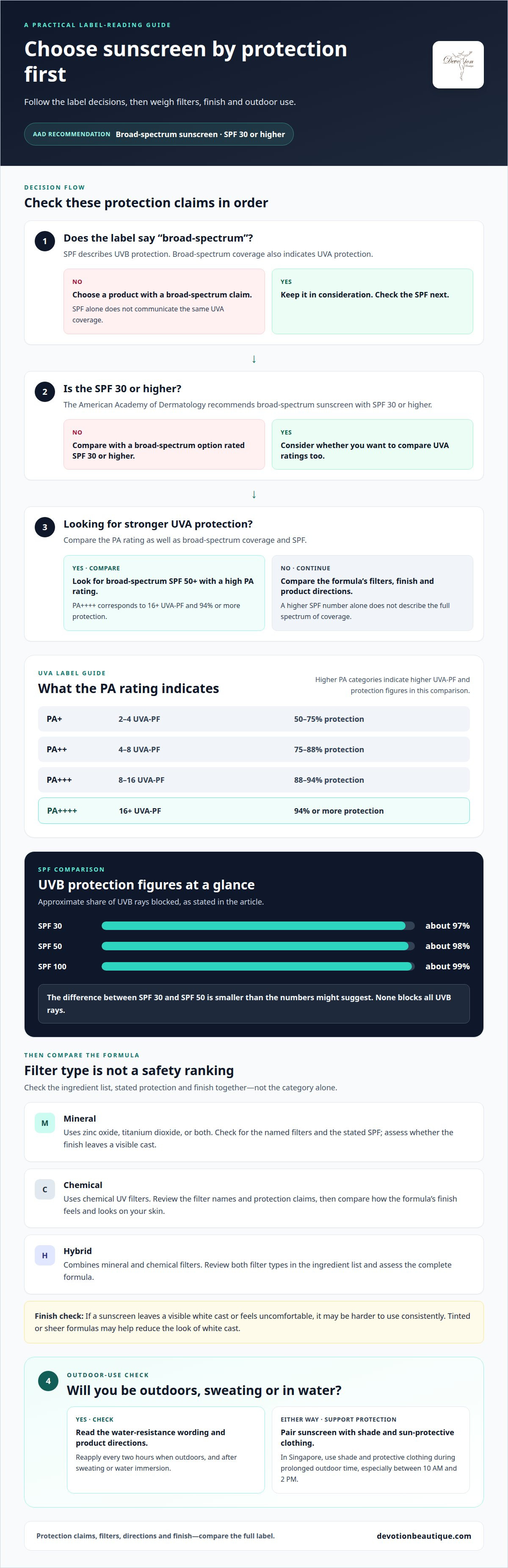
For strong UVA protection, compare broad-spectrum SPF 50+ with a high PA rating. PA++++ corresponds to 16+ UVA-PF and 94% or more protection. SPF measures UVB protection, so the number alone doesn’t describe the full spectrum of coverage.
Broad-Spectrum UVA and UVB Protection
UVA and UVB affect skin differently, which is why a broad-spectrum label matters. SPF describes protection against UVB, while broad-spectrum coverage also addresses UVA. A PA rating offers another way to compare UVA protection: PA+ corresponds to 2-4 UVA-PF and 50-75% protection; PA++ is 4-8 UVA-PF and 75-88%; PA+++ is 8-16 UVA-PF and 88-94%; PA++++ is 16+ UVA-PF and 94% or more.
These label details help distinguish products beyond their SPF number. A high SPF without a broad-spectrum claim does not communicate the same UVA coverage as a product labelled broad-spectrum. Check both when comparing formulas instead of treating SPF as a complete measure of protection.
SPF and Strong UVA Protection
The American Academy of Dermatology recommends broad-spectrum sunscreen with SPF 30 or higher. SPF 30 blocks about 97% of UVB rays, compared with about 98% for SPF 50 and 99% for SPF 100. The difference between SPF 30 and SPF 50 is smaller than the numbers might suggest, and none blocks all UVB.
The best sunscreen recommended by aestheticians for everyday use should pair a suitable SPF with broad-spectrum coverage. For stronger UVA protection, compare the PA rating too. A broad-spectrum SPF 50+ product with PA++++ provides a clearly stated combination of UVB and high UVA protection. Colorescience Sunforgettable Total Protection Face Shield Flex is listed as SPF 50, but SPF alone doesn’t establish its PA rating. A tinted finish may suit someone who prefers added colour, but tint doesn’t replace a broad-spectrum claim.
Daily protection can also support long-term skin care. Sun exposure is responsible for nearly 90% of visible signs of extrinsic aging. Zinc oxide is recommended for broad-spectrum protection from UVB through UV-A1, making it one ingredient to consider when comparing UVA coverage.
Pair sunscreen with shade and sun-protective clothing for added coverage. In Singapore, use shade and protective clothing during prolonged outdoor time, especially between 10 AM and 2 PM. Reapply sunscreen every two hours when outdoors, and after sweating or water immersion, since a high SPF label doesn’t remove the need to reapply.
To identify the best sunscreen recommended by aestheticians for strong UVA protection, compare the broad-spectrum claim, SPF and PA rating together. A thoughtful choice brings these label details into your routine alongside shade, protective clothing and reapplication.
Sunscreen product ingredients, sizes and water resistance
Compare facial sunscreens by their named filters, labelled protection, package size and water-resistance wording. A product name alone does not establish its finish, suitability for sensitive skin or how it performs beneath makeup.
There’s no rating data here to rank Singapore’s best-rated sunscreens. Useful examples for comparison include Colorescience Sunforgettable Total Protection Face Shield Flex SPF 50, EltaMD UV Clear Broad-Spectrum Face Sunscreen SPF 46, and Beauty of Joseon Daily Tinted Fluid Sunscreen SPF 40.
Ingredients add another point of comparison. EltaMD UV Clear Blemish-Prone & Oil Balancing SPF 50 contains 11% zinc oxide. La Roche-Posay Anthelios UVDefense SPF 50 Sunscreen with BEMT names BEMT in its product description. Read the complete ingredient list alongside the labelled spectrum protection; a single filter doesn’t tell you everything about a finished formula.
Water-resistance claims help distinguish products for outdoor routines. Supergoop! Unseen Sunscreen is listed as water-resistant for 40 minutes. Sunscreen labels may state water resistance for 40 minutes or 80 minutes. These are distinct labelled durations, not a reason to skip reapplication after sweating or water immersion.
Package size helps you assess how a product fits your routine and when you may need to replace it. Compare the volume printed on each package with how regularly you use sunscreen. A smaller facial format may be easier to carry, while a larger one may suit a regular home routine. Do not infer volume from a brand or product name.
Products in this comparison span several brands and finishes. Colorescience Face Shield Flex is listed at SPF 50, while the Beauty of Joseon option is tinted and SPF 40. Supergoop! Unseen Sunscreen’s name suggests an invisible finish, but the name alone can’t establish how it appears on every skin tone. Consider how a formula looks on your own skin, especially if white cast is a concern.
Prices depend on product size and retailer, so compare current Singapore listings rather than assuming a brand has one fixed price. Retailer listings and packaging can show available sizes, ingredients and water-resistance wording. The available comparisons do not establish specific Singapore stockists or a current local price for each example.
For a practical shortlist, compare products using the details their labels actually provide:
- Filter detail: EltaMD UV Clear Blemish-Prone & Oil Balancing SPF 50 lists 11% zinc oxide.
- Water resistance: Supergoop! Unseen Sunscreen is listed at 40 minutes.
- Finish: Beauty of Joseon Daily Tinted Fluid Sunscreen SPF 40 is explicitly tinted.
- Package choice: use the printed volume to compare formats, not assumptions based on brand.
A dermatologist-recommended label does not replace checking ingredients, protection and directions. Choose a formula whose documented features suit your routine, skin tone and preference for makeup or an invisible-looking finish.
Sunscreens for deeper skin tones and white-cast concerns
A sunscreen can offer labelled sun protection yet leave a finish that feels uncomfortable to wear. If you have a deeper skin tone, assess how the formula looks once spread and settled, not just its ingredient category. A visible white cast is a finish concern; it does not determine the SPF printed on the package.
Tinted formulas offer one option to explore. Beauty of Joseon Daily Tinted Fluid Sunscreen is listed as SPF 40 and tinted. Colorescience Sunforgettable Total Protection Face Shield Flex is listed as SPF 50, but the available product details don’t describe its finish across different skin tones. Compare the actual shade and appearance on your skin before making a formula part of daily skincare.
Skin type can guide texture preferences, but it does not replace checking the label. If your skin is oily or combination, a lighter-feeling formula may sit more comfortably under makeup. If your skin feels dry, you may prefer a more moisturising finish. These are preferences, not guarantees about how a particular product will feel.
Use a simple comparison routine when assessing face sunscreens:
- Check the labelled SPF and broad-spectrum claim first.
- Apply the formula evenly to a small area of the face.
- Let it settle, then observe the finish in natural light.
- Notice whether it feels comfortable alone and beneath your usual makeup.
That practical test helps compare colour, texture and layering without confusing appearance with protection. An invisible-looking finish may be a personal preference, but the word “invisible” in a product name doesn’t guarantee an identical result across skin tones. Supergoop! Unseen Sunscreen, for example, is listed as water-resistant for 40 minutes; that label describes water resistance, not a promise about its appearance on every face.
If your skin is prone to redness or sensitivity, review the full ingredient list and consider your known sensitivities. A mineral formula containing zinc oxide is one option to compare, but that ingredient alone cannot predict how your skin will respond. If a product repeatedly feels uncomfortable, its finish or ingredients may not suit your routine.
If you are prone to hyperpigmentation, make consistent sun protection part of your routine rather than choosing by tint alone. Compare the broad-spectrum claim, SPF and finish. A tinted sunscreen may look more natural on some skin tones, while a clear-looking formula may suit someone who prefers no visible tint. Neither appearance replaces the protection stated on the label.
In Singapore, choose a facial sunscreen you can apply evenly and wear throughout your usual routine. Prioritise labelled protection, then compare texture, tint and comfort. The most practical option is one whose finish works for your skin tone without making daily application feel like a compromise.
Aesthetician-recommended facial sunscreens
The best sunscreen recommended by aestheticians is one that combines suitable labelled protection with a finish you can wear consistently. Before deciding, compare each facial sunscreen’s SPF, broad-spectrum wording, ingredients and directions.
Mad Hippie Facial Sunscreen
Mad Hippie Facial Sunscreen is one facial option to assess by its product label. Compare its stated SPF and broad-spectrum wording with your preferred finish, then read the ingredients and directions. Its name alone does not tell you how it feels, layers beneath makeup or looks across different skin tones.
Use the same criteria for every product in your shortlist. The American Academy of Dermatology recommends broad-spectrum sunscreen with SPF 30 or higher. If you have known ingredient sensitivities, read the full list before adding a formula to your routine. Consider whether it sits comfortably over moisturiser and beneath makeup, rather than assuming that an “esthetician-approved” description guarantees a particular texture or result.
ISDIN Eryfotona Actinica SPF 50+ is another named facial sunscreen. Its listed SPF offers one point of comparison, but the product’s full label and directions remain important. A hydrating feel or antioxidant ingredient may suit your skin care preferences, but neither replaces the sunscreen’s stated protection. The best sunscreen recommended by aestheticians for your routine should be judged by its actual label and how readily you can use it as directed.
Separate Face and Body Sunscreens
Aestheticians do not need to recommend separate sunscreens for the face and body as a universal rule. You might choose a facial formula for its finish or compatibility with makeup, while a body formula may be more convenient for covering larger areas. Base your choice on the product’s labelled protection, directions and whether you can apply it as intended.
Application guidance distinguishes the areas: use ¼ teaspoon of sunscreen on the face and 1 ounce (30ml) on the body per application. Apply sunscreen as the last step of your skincare routine, after moisturiser and before makeup. These amounts can help you plan product use, but they don’t make separate facial and body formulas essential.
For a practical routine, choose a facial sunscreen you can apply evenly each day. If you use a different formula on your body, follow its package directions rather than assuming the facial product’s texture or format suits every area. Reapply every two hours when outdoors, and after sweating or water immersion. Consistent use, paired with a comfortable finish, makes protection easier to maintain.
Devotion Beautique: Advanced Aesthetic Series Skin Boosting RETREAT
If your interest extends beyond choosing sunscreen to a more considered approach to skin care, Devotion Beautique offers the Advanced Aesthetic Series Skin Boosting RETREAT. It complements, rather than replaces, daily sun protection.
A personalised facial programme may suit skin goals such as hydration, brightening, firming, calming or repair. Devotion Beautique’s ReProgram Facial and Remedial Facial are options within its facial offerings. A tailored treatment can complement a consistent home routine, while sunscreen remains your daily protection against UV exposure.
If you’re considering how facial care could support your skin goals, contact Devotion Beautique to discuss the Advanced Aesthetic Series Skin Boosting RETREAT.
Make Your Skin Care Routine More Personal
Your sunscreen routine can be a thoughtful starting point for wider skin care goals. Consider what you want your daily care to support, whether that’s a more comfortable routine, a finish you enjoy wearing or a personalised approach to facial care. These preferences can help you have a more focused conversation about your next step.
For support beyond product selection, Devotion Beautique offers the ReProgram Facial as part of its treatment facials. It may suit you if you’re considering a treatment programme alongside your established home care. A facial treatment complements your routine; it does not replace sunscreen or regular use.
Ready to discuss how sunscreen fits your skin care priorities? Contact Devotion Beautique for sunscreen advice. Keep building a routine that feels considered, consistent and suited to you.
Frequently Asked Questions
Can sunscreen cause breakouts?
Yes, a sunscreen’s texture or ingredients can contribute to congestion for some people. If blemishes appear after introducing a formula, consider whether it feels heavy or layers poorly with moisturiser and makeup. Simplify the rest of your routine while assessing the change, rather than replacing several products at once. Choose a facial formula that feels comfortable, and cleanse thoroughly at the end of the day.
How often should I reapply sunscreen?
Reapply every two hours when outdoors, and after sweating or water immersion. For example, if you apply sunscreen before a lunchtime walk, plan another application during an extended time outdoors. Keep the product with you so reapplication is practical. Follow the label’s directions too, particularly if your activity involves water or heavy perspiration.
Is tinted sunscreen better than non-tinted?
Neither finish is universally better. Choose the one you can apply evenly and wear consistently. A tinted formula adds colour, while a non-tinted option may suit someone who prefers no visible tint. Check the shade against your skin in daylight and consider how it layers with makeup. Keep SPF and protection claims central to your decision.
What about water resistance?
Water-resistance labels commonly state 40 minutes or 80 minutes. Treat that wording as a product-specific direction, not as permission to ignore reapplication. After sweating or water immersion, reapply sunscreen; when outdoors, reapply every two hours. For a swim or active day, choose a formula whose labelled water resistance suits the activity, then follow its package directions.
Which sunscreens do aestheticians recommend most often?
There isn’t a universal frequency ranking in the product comparisons here. Named facial options include ISDIN Eryfotona Actinica SPF 50+, EltaMD UV Clear Broad-Spectrum Face Sunscreen SPF 46, and Colorescience Sunforgettable Total Protection Face Shield Flex SPF 50. Treat these as examples to compare, not a definitive ranking. Check each product’s current packaging for its ingredients, directions and protection claims.
What is the difference between mineral and chemical sunscreen, and which do aestheticians prefer?
Mineral sunscreens use zinc oxide, titanium dioxide, or both; chemical sunscreens use chemical UV filters. Hybrid formulas combine filter types. No single preference suits everyone or every routine. Compare the labelled protection and ingredient list, then consider which finish you can comfortably wear. If you have a known sensitivity, review the full label rather than choosing by category alone.
Which sunscreens suit oily, acne-prone, sensitive, dry, or mature skin?
Start with a finish you find wearable: a lighter-feeling facial formula may suit oily skin, while you may prefer a more moisturising texture if that feels better. For sensitive skin, read the full ingredient list and avoid known personal triggers. If you have mature skin, compare the protection claim and how the product fits your routine. Skin type can guide texture preferences, but it does not replace checking the label.
Which sunscreen ingredients should people with sensitive skin or allergies avoid?
Avoid ingredients you already know trigger a sensitivity or allergy; there is no universal avoid-list for everyone. Read the complete ingredient list on the packaging, even when repurchasing a familiar sunscreen, because formulas may evolve. If an ingredient name is unclear, a pharmacist or clinician can help interpret it in light of your known allergies. Stop using a product that causes a reaction.
