
Sensitive Skin Causes: A 2026 Guide to Understanding Modern Reactivity
Did you know that as of 2026, up to 70% of the global population now reports some form of skin reactivity? This staggering rise in what experts call Sensitive Skin Syndrome suggests that modern sensitive skin causes are more prevalent than ever, placing unprecedented stress on our biological defenses. It’s exhausting to navigate persistent redness or the fear that every new treatment will trigger a flare up. You might feel as though your skin barrier is permanently compromised, leaving you stuck in a cycle of irritation and confusion over conflicting advice.
We’re here to help you decode these signals and reclaim your complexion’s natural strength. By understanding the core triggers, from urban pollution to internal stress, you can move past temporary fixes toward genuine cellular health. This guide explores the critical distinction between genetic and acquired sensitivity, identifies the environmental triggers unique to 2026, and outlines a sophisticated restoration strategy designed by experts like Karen Goh, who brings 31 years of mastery to the art of skin repair. It’s time to transform your relationship with your skin and rediscover a sense of calm, resilient beauty.
Key Takeaways
- Distinguish between inherited genetic sensitivity and acquired sensitization to better understand your skin’s unique history and needs.
- Uncover how modern sensitive skin causes, including microscopic pollution and rapid humidity shifts, trigger the “pollution pore” effect and oxidative stress.
- Explore the mechanics of the skin barrier and how transepidermal water loss (TEWL) creates the persistent discomfort and “tight” feeling of reactive skin.
- Implement a strategic “skincare detox” and tracking diary to isolate specific triggers within your daily routine and environmental surroundings.
- Move beyond temporary soothing with advanced restoration strategies that focus on biological regeneration and long-term barrier resilience.
The Rise of Reactive Skin: Is it Sensitivity or Sensitization?
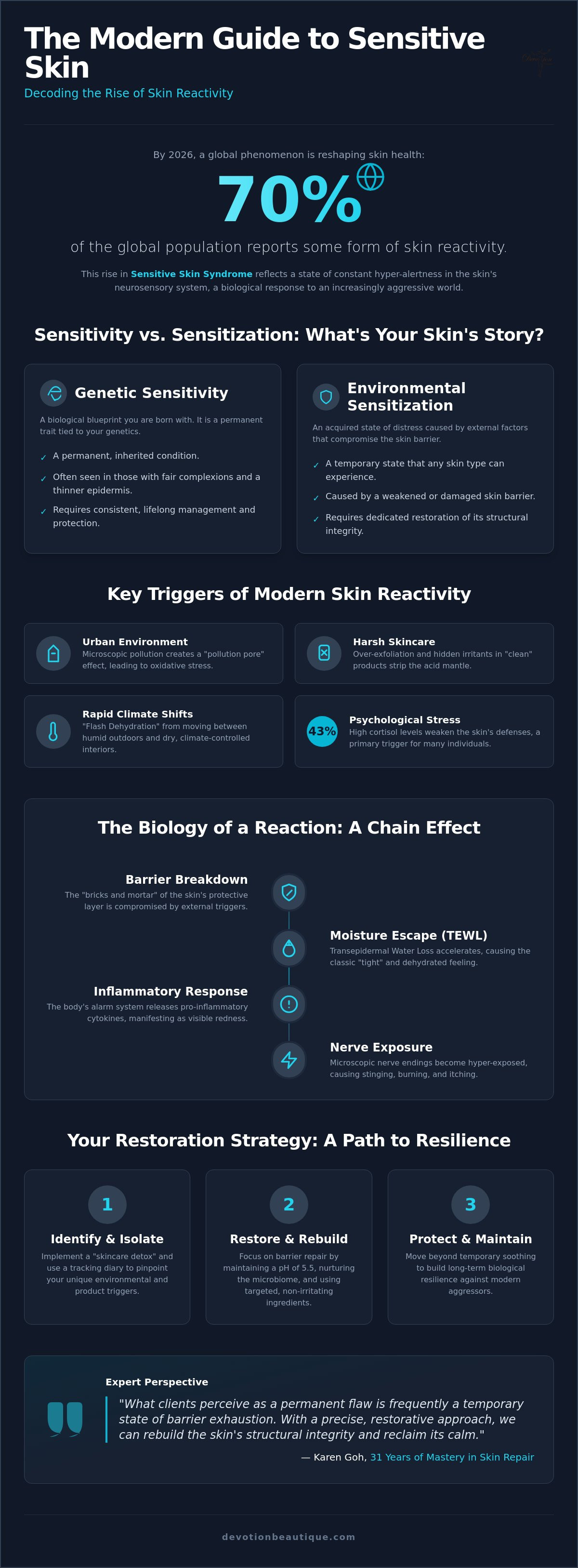
As we navigate the complexities of 2026, the dermatological landscape has shifted significantly. Experts now recognize a global phenomenon known as “Sensitive Skin Syndrome,” a condition where the skin’s neurosensory system remains in a state of constant hyper-alert. Recent data reveals that up to 70% of the global population now reports some form of reactivity. This isn’t just a coincidence. It is a biological response to an increasingly aggressive world. To truly grasp What is sensitive skin?, we must look beyond the surface redness. Understanding the modern sensitive skin causes is the first step toward reclaiming a sense of calm. Your skin is sending an SOS. It communicates through stinging, burning, and the subtle heat of invisible inflammation. These signals are not just inconveniences; they are requests for a more refined, tailored approach to care.
Differentiating Genetic Sensitivity from Environmental Sensitization
There is a crucial distinction between being born with sensitive skin and having skin that has become sensitized. Genetic sensitivity is a biological blueprint often seen in those with a fair complexion and a naturally thinner epidermis. It is a permanent trait that requires lifelong management. Sensitization, however, is an acquired state of distress. It happens when the skin barrier is compromised, allowing irritants to penetrate deeper than they should. Any skin type can become sensitized. Karen Goh, with 31 years of specialized expertise, often observes that what clients perceive as a permanent flaw is frequently a temporary state of barrier exhaustion. While sensitive skin needs protection, sensitized skin requires a dedicated restoration of its structural integrity.
The Modern Epidemic of Skin Hyper-reactivity
Why are we seeing such a sharp increase in reactivity today? The answer often lies in the “clean beauty” paradox. In the pursuit of health, many people overload their routines with active botanicals and essential oils that actually act as hidden irritants. Over-exfoliation has become a modern epidemic, stripping away the acid mantle before it can regenerate. Beyond our bathrooms, the urban environment acts as a constant, low-grade aggressor. Microscopic pollution particles and the “flash dehydration” caused by moving between humid outdoors and dry, climate-controlled interiors create a perfect storm for reactivity. There is also a powerful psychological link to consider. Stress is a primary trigger for 43% of individuals with sensitive skin. High cortisol levels weaken the skin’s defenses, proving that our complexion is a direct reflection of our internal and external harmony.
Biological Foundations: What Actually Causes Skin to React?
Behind the stinging and heat discussed previously lies a complex biological failure. Your skin barrier, or stratum corneum, acts as the definitive protector against the world. When this “bricks and mortar” structure is intact, it locks in moisture and repels irritants with effortless grace. However, modern sensitive skin causes often involve a microscopic breakdown of these essential lipids. This breach leads to Transepidermal Water Loss (TEWL), the precise mechanism that creates that uncomfortable, “tight” sensation after cleansing. As water escapes, the skin’s internal alarm system activates. Pro-inflammatory cytokines flood the area, manifesting as the visible redness that so many find distressing. Simultaneously, the microscopic nerve endings in your epidermis become hyper-exposed. Without a thick, healthy barrier to cushion them, even the gentlest breeze or temperature shift can feel like a direct assault. It’s a state of constant biological tension that requires a nurturing, expert touch to resolve.
The Acid Mantle and pH Disruption
Your skin’s health depends on a delicate, slightly acidic environment. A pH of 5.5 is non-negotiable for maintaining the structural integrity of the acid mantle. Many commercial cleansers are surprisingly alkaline, stripping away the protective lipid layer in seconds. This disruption creates a hospitable environment for pathogenic bacteria while silencing the enzymes responsible for barrier repair. Understanding the various types of skin sensitivity helps clarify that most reactivity isn’t an allergy, but a direct consequence of this chemical imbalance. When the pH is compromised, the skin’s ability to self-heal vanishes. To begin your journey toward recovery, the Remedial Facial serves as an essential first step in restoring this vital pH harmony. This approach is rooted in the 31 years of clinical mastery Karen Goh has dedicated to skin health, ensuring every treatment is as precise as it is restorative.
Microbiome Imbalance: The Silent Trigger
Beyond the chemical layers, your skin is a thriving ecosystem. The skin microbiome acts as a living shield, outcompeting harmful microbes and communicating with your immune system to prevent unnecessary inflammation. We often see clients who have over-sanitized their skin with harsh “clean” products, believing that “sterile” means healthy. In reality, a lack of microbial diversity weakens your skin’s innate immunity, making it far more susceptible to external aggressors. The microbiome is the invisible architect of your skin’s defense, ensuring that your complexion remains calm and resilient against the stressors of urban life. A balanced microbiome doesn’t just prevent sensitivity; it fosters a vibrant, glowing health that radiates from within.
Modern Trigger Analysis: External and Internal Aggressors
While the biological mechanics of barrier failure are clear, the catalysts are often found in our daily environment. These modern sensitive skin causes are frequently invisible, yet their impact is cumulative. City dwellers face a unique challenge: the “Pollution Pore” effect. Microscopic particulate matter, specifically PM2.5, is small enough to enter the pores. Once inside, it triggers oxidative stress and a cascade of inflammation that exhausts the skin’s natural defenses. This isn’t just about surface dirt; it’s about a deep, cellular intrusion that keeps the skin in a state of constant high alert.
Urban Stressors: Pollution, Blue Light, and Climate
Living in a digital, urbanized world means our skin is under constant surveillance by High-Energy Visible (HEV) light. This blue light, emitted from our ubiquitous screens, acts as a catalyst for inflammatory responses. It accelerates the breakdown of collagen and further sensitizes the epidermis. We also see the hidden impact of climate control. Moving from humid outdoor air into dry, air-conditioned spaces causes “flash dehydration.” This is a rapid loss of moisture that leaves the skin brittle and reactive. Even the water you use to cleanse can be a factor. Hard water contains high mineral concentrations that can leave a residue, disrupting the acid mantle we discussed earlier and making the skin feel perpetually tight.
Lifestyle and Internal Influences
The skin doesn’t exist in a vacuum; it is deeply connected to our internal health. Hormonal fluctuations during puberty, pregnancy, or menopause are significant sensitive skin causes that often go unaddressed. These shifts can alter sebum production and barrier thickness, making previously resilient skin suddenly reactive. Our dietary choices play a role too. High-sugar diets are linked to systemic inflammation, which often manifests on the surface as persistent redness or heat. It’s a reminder that what we ingest is just as vital as what we apply.
Chemical exposure is another critical layer. Many individuals suffer from the “cocktail effect,” where the combination of fragrances and preservatives across multiple products creates a reaction that no single ingredient would cause on its own. This sensitivity can even stem from our professional lives. Research into Occupational Skin Diseases highlights how routine exposure to seemingly benign substances can lead to chronic irritant contact dermatitis. Finally, the nocturnal repair cycle is non-negotiable. During deep sleep, the skin focuses on cellular regeneration and barrier repair. When sleep is cut short, these restorative processes are interrupted. Recognizing these multifaceted triggers is essential. It’s why Karen Goh, with 31 years of experience, emphasizes that a one-size-fits-all solution is never enough. Every skin history is different, and every recovery must be bespoke.
Mapping Your Skin’s History: Identifying Your Specific Causes
Uncovering the specific sensitive skin causes unique to your life requires a shift from reactive guessing to methodical observation. While we’ve explored the biological mechanisms and urban stressors, your skin’s history is a personal narrative that demands a tailored response. Self-diagnosis often leads to a “product graveyard” of half-used bottles that only further confuse the complexion. Professional analysis remains the gold standard. Karen Goh, with 31 years of mastery in skin health, emphasizes that identifying the root cause is far more effective than simply masking the symptoms. It’s about moving from a state of fear to one of informed confidence.
A “Skin Diary” serves as your most powerful tool in this journey. By meticulously documenting the interplay between your environment, diet, and daily routine, you begin to see patterns that a single mirror glance could never reveal. Track the humidity levels in your office, the timing of your flare-ups, and even your stress levels. This data provides the clinical context needed to design a truly restorative path. If you’re ready to stop the cycle of irritation, the Remedial Facial offers a professional sanctuary to assess your barrier health and begin immediate, expert-led calming.
The ‘Over-processed’ Skin Cycle
Many modern routines are simply too aggressive. The desire for rapid results often leads to an “active ingredient cocktail” where high concentrations of Retinol, Vitamin C, and various acids are used simultaneously. This leads to chronic sensitization. Your skin doesn’t need more; it needs better. Adopting a “Less is More” philosophy allows the epidermis to breathe and begin its natural repair process. When you eventually reintroduce products, do it with intention. Start small. Introduce one formula at a time over two weeks to ensure your barrier remains unbothered and resilient.
A Self-Assessment Framework for Reactive Complexions
To begin your own mapping process, use this structured framework to categorize your skin’s behavior:
- Step 1: Visual vs. Sensory Symptoms. Is your skin visibly red and peeling, or do you only feel a deep stinging sensation? Sensory reactivity often points to hyper-exposed nerve endings, while visual symptoms suggest a structural barrier breach.
- Step 2: Timing of Reactions. Do you react immediately upon product application, or does the irritation appear 24 hours later? Immediate reactions are typically irritant-based, while delayed responses often signal a deeper allergic sensitivity.
- Step 3: Environmental Impact. Notice how your skin feels when moving between the humid Singapore air and dry, climate-controlled interiors. This “flash dehydration” is a major catalyst for modern reactivity.
Understanding these nuances is essential for restoring your skin’s acid mantle and ensuring long-term health. By identifying your specific triggers, you transform your skincare from a source of stress into a nurturing ritual of self-care.
Beyond Soothing: Advanced Restoration for Lasting Resilience
Soothing products often act as a temporary veil. While they offer immediate relief, they rarely address the underlying sensitive skin causes that lead to chronic reactivity. True transformation requires moving beyond the ‘gentle’ label toward active structural restoration. Most mass-market products for reactive skin focus on what to leave out, rather than what to put in. This ‘band-aid’ approach might stop the stinging today, but it does nothing to prevent the flare-up of tomorrow. Professional aesthetic treatments provide the precision needed to recalibrate your skin’s biological environment, shifting it from a state of constant defense to one of quiet, enduring resilience.
Recalibrating the skin’s pH and moisture levels is a delicate art. It requires a deep understanding of cellular health and the ability to read the skin’s individual history. By introducing professional-grade ingredients in a controlled, clinical environment, we can encourage the skin to repair its own barrier. This process moves you away from the fear of trying new things and toward a future where your skin is capable of handling the modern world with ease. It’s about empowerment through expertise.
Professional Remedial Care: Repairing the Structural Anchors
The Remedial Facial serves as the foundational architecture for this recovery. It isn’t merely a topical application; it’s a scientific intervention designed to strengthen the dermal-epidermal junction. We utilize targeted peptide infusions that act as biological messengers, signaling your skin to produce the essential lipids it lacks. Professional-grade formulas surpass high-street ‘sensitive’ brands because they are bio-available. They don’t just sit on the surface. They penetrate where they are needed most to support long-term skin health. This structural repair is what finally stops the cycle of transepidermal water loss and chronic inflammation.
The Devotion Approach: Customised Calibration
Our ‘ReProgram’ philosophy focuses on teaching your skin to defend itself again. It’s a methodical process of calibration that respects your skin’s current limits while pushing toward a stronger future. For those seeking the ultimate in structural recovery, the Skin Boosting RETREAT offers deep biological regeneration. This isn’t a generic procedure. It is a curated journey guided by the 31 years of expertise Karen Goh brings to every consultation. Having a dedicated mentor in your skincare journey is vital for sensitive types. It provides the quiet confidence that comes from knowing every step is backed by decades of mastery and a grounded, client-centered philosophy. You don’t have to navigate your reactivity alone; we are here to lead you back to balance.
Reclaiming Your Skin’s Natural Resilience
Understanding the multifaceted sensitive skin causes unique to your lifestyle is the essential first step toward a permanent solution. We’ve explored how modern sensitization often stems from urban stressors and routine overload, rather than just genetic traits. Moving beyond temporary soothing to structural barrier recovery allows your complexion to thrive in any environment. It’s time to stop managing irritation and start building true cellular strength. Your skin’s history doesn’t have to dictate its future.
You don’t have to navigate this journey alone. With 31 years of aesthetic expertise, Karen Goh provides the specialized mastery required for long-term transformation. Our customized Remedial and ReProgram facial programmes are designed to recalibrate your skin’s biological defenses, ensuring you move from reactivity to lasting strength. Expert-led skin barrier recovery is within your reach. Begin your journey to resilient skin with a bespoke consultation. Your skin has a remarkable capacity for renewal; it’s simply waiting for the right guidance to begin.
Frequently Asked Questions
What are the most common external sensitive skin causes?
Modern environmental stressors like microscopic PM2.5 pollution and rapid humidity shifts are the most prevalent external triggers. These particles infiltrate the pores to cause oxidative stress while moving between humid outdoor air and dry, air-conditioned spaces leads to “flash dehydration.” Additionally, routine exposure to harsh household chemicals and synthetic fragrances often contributes to a cumulative state of sensitization that weakens your natural defenses.
Can I suddenly develop sensitive skin as an adult?
Yes, any skin type can become sensitized at any age due to barrier damage or lifestyle shifts. Unlike genetic sensitivity, which is present from birth, acquired sensitization is often one of the sensitive skin causes triggered by over-exfoliation, hormonal changes during pregnancy or menopause, or chronic stress. It’s a signal that your skin’s protective mantle has been compromised and requires professional recalibration to restore its health.
How do I tell the difference between an allergy and sensitive skin?
The primary difference lies in the timing and the nature of the reaction. An allergy is an immune system response that often manifests as itching, hives, or swelling, sometimes appearing hours or days after contact. Sensitivity is typically a localized, immediate reaction; such as stinging, burning, or redness; caused by a compromised barrier that allows irritants to reach hyper-exposed nerve endings in the epidermis.
Is hard water a cause of skin sensitivity?
Hard water is a significant but frequently overlooked factor in skin reactivity. The high concentration of minerals like calcium and magnesium can leave a microscopic residue on the skin’s surface, which disrupts the natural pH balance and strips away essential lipids. This residue makes it harder for cleansers to rinse away properly, leading to persistent dryness and a “tight” feeling that eventually breaches the skin barrier.
Can stress actually cause my skin to break out in rashes or redness?
Stress is a powerful biological trigger that directly impacts your skin’s resilience. High cortisol levels weaken the skin’s barrier function and trigger the release of pro-inflammatory cytokines, which manifest as visible redness and heat. In fact, nearly 43% of individuals with reactive complexions identify high stress as a primary catalyst for their flare ups, proving the deep connection between your internal state and external glow.
What ingredients should I avoid if my skin is highly reactive?
You should prioritize avoiding denatured alcohols, synthetic fragrances, and harsh sulfates like Sodium Lauryl Sulfate (SLS), which strip the acid mantle. High concentrations of active acids or unstable forms of Vitamin C can also be primary sensitive skin causes when the barrier is already weak. Instead, look for physiological lipids and calming peptides that support the dermal-epidermal junction without causing further distress.
How long does it take to repair a damaged skin barrier?
A full barrier recovery typically follows the skin’s natural renewal cycle, which takes between 28 and 45 days. While initial soothing can happen quickly, deep structural repair requires consistent, gentle care to allow new, healthy cells to reach the surface. For lasting resilience, professional guidance from an expert like Karen Goh, who brings 31 years of mastery to skin repair, can ensure the recovery is both thorough and permanent.
Should I stop using all skincare if my skin is acting up?
Stopping all skincare, often called a “skincare fast,” can actually leave your compromised barrier more vulnerable to environmental aggressors. Instead of quitting entirely, transition to a “Barrier Reset” routine. This involves using only a gentle, pH-balanced cleanser and a nourishing, lipid-rich moisturizer. This minimal approach protects the skin while giving the acid mantle the quiet environment it needs to begin the natural process of self-repair.
