
Hyaluronic acid facials for dry skin: products and results
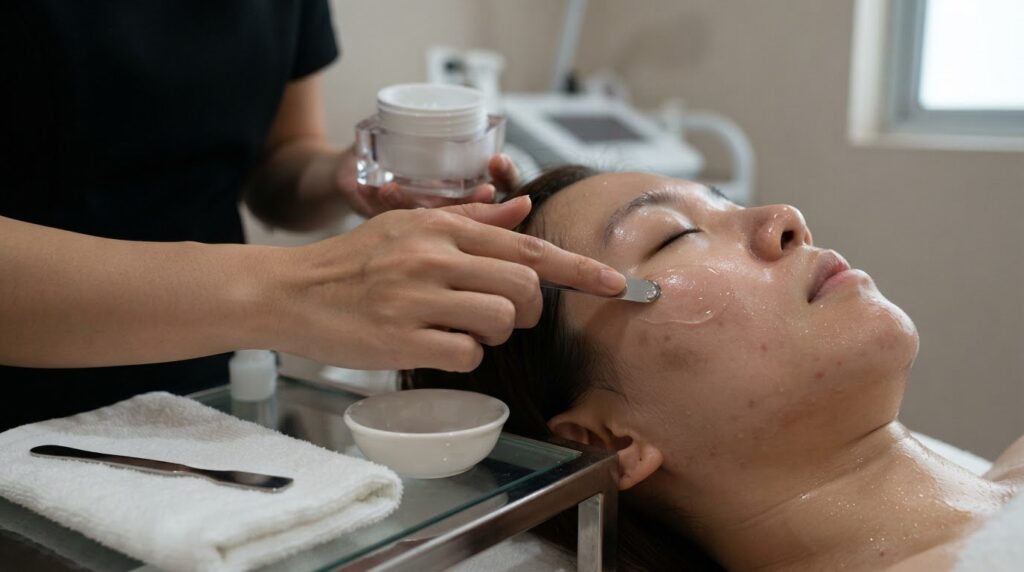
More hyaluronic acid does not automatically mean lasting moisture. A hyaluronic acid facial for dry skin can support hydration, including for sensitive skin, but hyaluronic acid attracts water rather than sealing it in. Dry skin usually also needs moisturiser to help retain that hydration.
When skin feels tight or easily unsettled, a soothing treatment may sound appealing. Hyaluronic acid is generally considered suitable for sensitive skin, but it may not be enough on its own for severely dry, cracked or persistently irritated skin. How it is combined with other skincare matters, too.
This guide explains how hyaluronic acid works, what to look for in topical products, and how a professional facial differs from at-home skincare in its potential benefits and limits. You’ll also learn why applying the ingredient to damp skin and following with moisturiser can support hydration, and when persistent discomfort calls for a dermatologist’s care.
Key Takeaways
- Distinguish dry skin from dehydration: oily skin can also lack water, and that difference can guide product selection.
- Look beyond the ingredient name. A serum’s formulation and supporting ingredients influence how it fits into a skincare routine.
- Hyaluronic acid hydrates but doesn’t exfoliate, so it may not address concerns that call for other types of care.
- A professional facial can be tailored to your skin’s needs, while its benefits depend on the treatment approach and your skin’s response.
- For a personalised skin-focused treatment programme, explore Devotion Beautique’s Advanced Aesthetic Series Skin Boosting RETREAT.
Is Hyaluronic Acid Good for Dry Sensitive Skin?
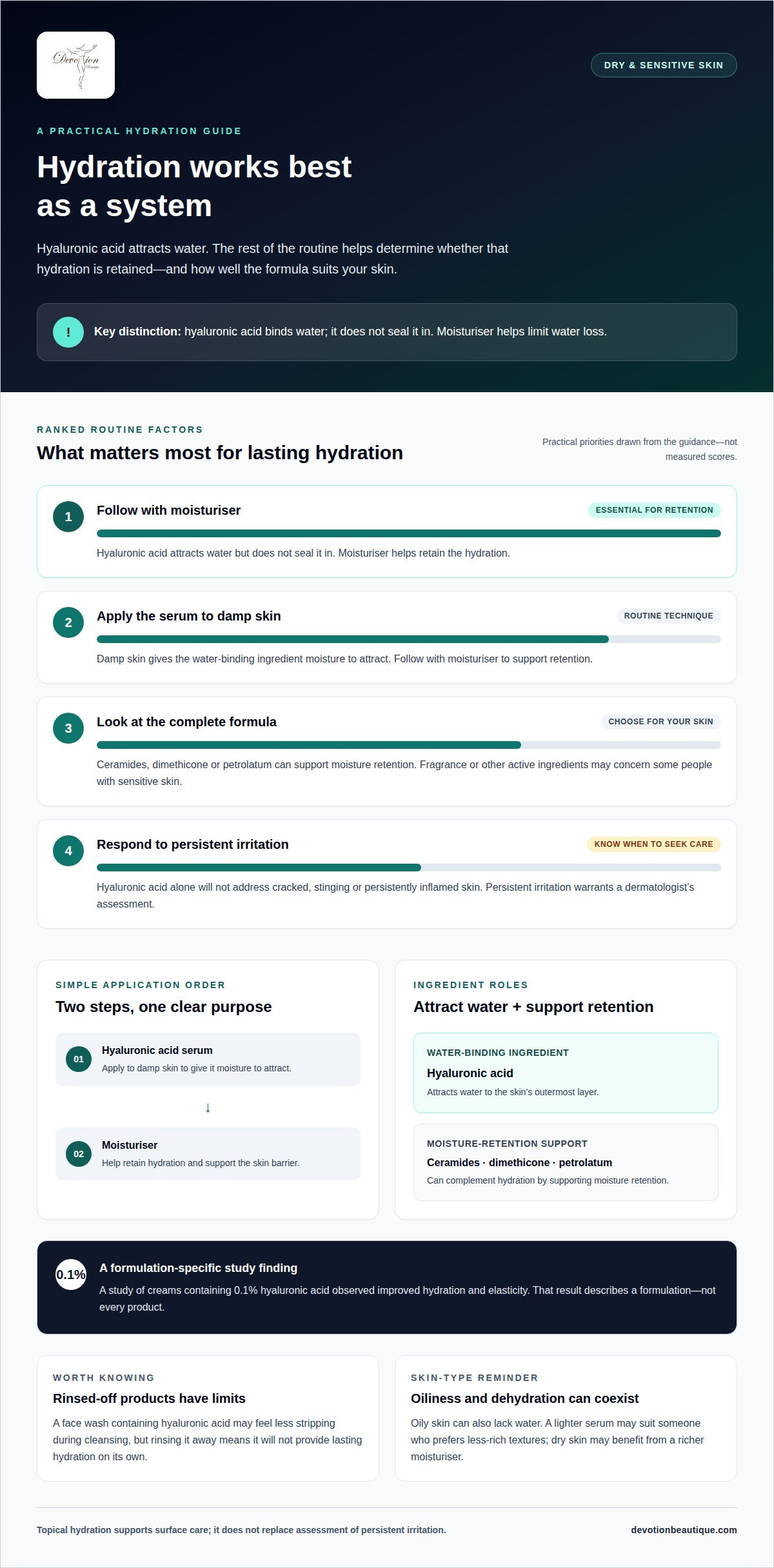
Hyaluronic acid can support hydration in dry, sensitive skin by binding water in the outermost layer. Its benefit depends on the complete routine, especially whether moisturiser helps retain that water.
How Hyaluronic Acid Hydrates Skin
Hyaluronic acid is a water-binding ingredient that temporarily increases hydration in the skin’s outermost layer. For dry skin, this can help soften a tight, dehydrated feel without acting as an exfoliant. Sodium hyaluronate, a stable form often used in serums, provides another label name to recognise. A study of creams containing 0.1% hyaluronic acid observed improved hydration and elasticity, though that result describes a formulation, not every product.
Moisture Retention in Dry Skin
Moisture retention means limiting water loss after a humectant such as hyaluronic acid draws water to the skin. Hyaluronic acid attracts water but does not seal it in; moisturiser helps do that. Pairing hydration with barrier-supporting ingredients, such as ceramides or dimethicone, can address both needs. In very low-humidity environments, applying hyaluronic acid to completely dry skin without moisturiser may draw water from deeper layers, where it can evaporate.
Application matters. A common routine is to apply hyaluronic acid serum to damp skin, then follow with moisturiser. This gives the water-binding ingredient moisture to attract and adds a layer that supports retention. A face wash containing hyaluronic acid may feel less stripping during cleansing, but rinsing it away means it will not provide lasting hydration on its own.
Sensitive skin can often use hyaluronic acid, including in products formulated for sensitive skin, but the full ingredient list matters. Fragrance or other active ingredients may concern some people, so a gentle, uncomplicated formula can be easier to assess. If skin is cracked, stinging or persistently inflamed, hyaluronic acid alone will not address the underlying concern; persistent irritation warrants a dermatologist’s assessment.
Singapore injectable hydration treatments differ from topical serums: injections place a product beneath the skin rather than applying it to the surface. Hyaluronic acid injections should only be given by a licensed, qualified medical professional. For an injectable treatment, check the practitioner’s credentials and qualifications; for a non-injectable facial, ask how the ingredients and treatment approach suit your skin concerns.
The distinction matters because “hydration” can describe different approaches. A topical hyaluronic acid facial for dry skin focuses on surface care, while an injectable treatment involves a medical professional and a different method. Neither replaces daily moisture retention. For dry, sensitive skin, consider the product formula, how it is paired with moisturiser, and whether irritation is persistent before choosing an approach.
Hyaluronic acid products for different skin types
Hyaluronic acid appears in serums and other skincare products for dry, sensitive, aging and acne-prone skin. The right format depends on what else your skin needs, not just its skin type. For dry skin, look for a formula that combines humectants with barrier-supporting ingredients. Ceramides, dimethicone and petrolatum can complement hydration by supporting moisture retention. A serum containing hyaluronic acid alone may not meet every need, particularly if skin also feels rough or easily irritated.
Check the ingredient list as well as the product name. Sodium hyaluronate is a stable form of hyaluronic acid commonly used in serums. Formulations can also pair hyaluronic acid with ceramides, fatty acids, shea butter or colloidal oatmeal. These ingredients serve different roles: hyaluronic acid attracts water, while richer moisturising ingredients help support the skin barrier. Choosing based on the complete formula can be more useful than relying on a “dry skin” label alone.
Skin type does not always describe hydration needs. Oily skin can also be dehydrated because excess sebum and lack of water are separate concerns. A lighter serum may suit someone who prefers less-rich textures, while dry skin may benefit from a moisturiser containing humectants alongside ceramides, dimethicone or petrolatum. Sensitive skin can use hyaluronic acid, but the overall formula matters; fragrance and other active ingredients may not suit everyone.
Hyaluronic acid can be used alongside retinol, vitamin C and peptides. That compatibility does not mean every active belongs in the same step or suits every skin concern. In a layered routine, apply hyaluronic acid serums before water-free serums. If your evening routine includes an AHA or BHA treatment, apply that treatment before the hyaluronic acid serum. Keeping the sequence clear helps distinguish each product’s role.
Fine lines and wrinkles may look more noticeable when skin lacks hydration, so a moisturising routine can support a smoother-looking appearance. However, hyaluronic acid does not exfoliate or replace ingredients chosen for other concerns. Select products based on your skin’s condition, texture preferences and existing routine. For example, someone with oily but dehydrated skin may prefer a lighter serum, while dry skin may call for a richer moisturiser containing barrier-supporting ingredients. The formulation, not the ingredient name alone, shapes how a product fits into skincare.
Benefits and limitations of topical hyaluronic acid
Topical hyaluronic acid can temporarily improve hydration and soften the look of dehydration-related lines. Its benefits focus on moisture and appearance, so it does not replace care for persistent irritation or a damaged skin barrier.
Effects on Dry Lines and Appearance
Hydrated skin can look smoother because water helps it stretch and flex. This may soften the appearance of fine lines that look more pronounced when skin is dry. The effect concerns how skin looks and feels, not the removal of established wrinkles. For example, a topical serum can support a temporarily plumper appearance without exfoliating or resurfacing the skin.
That distinction helps set realistic expectations. Hyaluronic acid does not promote the shedding of dead skin cells, so it will not perform the role of an exfoliating active. Someone concerned about uneven texture or persistent lines may need a different approach to those concerns. Hydration is one part of skin appearance, not a solution for every visible change.
Benefits for Dry Sensitive Skin
Hyaluronic acid is a gentle ingredient found in products made for sensitive skin. By supporting surface hydration, it can help dry skin feel more comfortable and flexible. This can matter when tightness makes a familiar skincare routine feel less pleasant. The product’s full formula still matters, since the ingredient is only one part of what touches the skin. For those curating a thoughtful routine, exploring mindful beauty ranges such as Avin & Holy Glow can provide gentle options that support overall skin wellness.
Topical hyaluronic acid products are considered safe, and adverse reactions are rare. Still, the ingredient alone will not fix severely dry skin that is cracked, stinging or persistently inflamed. Those symptoms need more than a hydrating active; persistent redness, cracking or painful irritation are reasons to seek a dermatologist’s assessment. Do not treat ongoing discomfort as a simple lack of moisture.
Expected Results and Their Duration
A hyaluronic acid facial using topical products can leave skin feeling more hydrated and looking temporarily plumper, which may soften the appearance of dry lines. The effect is temporary, not a permanent change to wrinkles or skin structure. Its duration depends on the treatment formulation and how the skin is cared for afterward.
Moisturiser and ongoing skincare influence how well skin retains hydration after a facial. A topical treatment can attract water, but it does not seal that moisture in by itself. Results are best understood as a short-term improvement in hydration and appearance, not a fixed duration or lasting correction. A facial also cannot replace assessment of persistent skin symptoms.
Consider the treatment’s purpose before choosing it. If your main concern is dryness and a temporarily smoother appearance, topical hyaluronic acid may support that goal. If you expect it to exfoliate, erase established wrinkles or resolve cracked and inflamed skin, remember its limits. Matching the treatment to your concern helps keep expectations grounded and supports a more considered skincare plan.
Hyaluronic acid in professional facials
A professional facial uses topical products as part of a broader skin-focused treatment, rather than relying on one ingredient alone. For dry skin, the key is how the treatment pairs hydration with steps that support comfort and moisture retention.
What the Facial Involves
A topical hyaluronic acid facial is a professional skincare treatment that applies a water-binding humectant to the skin. Hydration depends on the whole treatment, including what follows the serum. Hyaluronic acid helps attract water, while moisturiser supports retention. The product’s molecular weight and accompanying ingredients shape the formulation; they do not guarantee deeper delivery or lasting results.
Think of the facial as a sequence of complementary choices. A professional considers dryness, sensitivity and current skin concerns before selecting products. For example, a simple hydrating formula may suit dry, easily unsettled skin better than a treatment layered with several active ingredients. Adding vitamin C or another active changes the overall formulation and should reflect the skin’s needs.
Topical hydration is distinct from injectable treatment. A serum sits on the skin’s surface; it does not become an injection simply because it contains hyaluronic acid. The distinction matters in Singapore, where readers may encounter descriptions of both treatments. This section concerns topical facials, not injectable procedures or claims about what an injection can deliver.
Steps in the Facial
A topical facial commonly follows a considered sequence: assess the skin, cleanse it, apply a hydrating product, then finish with moisturiser. The assessment helps the professional account for dryness and sensitivity before choosing ingredients. Applying serum to damp skin and following it with moisturiser supports both the humectant’s role and moisture retention.
Each step should serve a purpose, rather than simply add layers. For example, a professional may keep the routine focused when skin feels reactive instead of adding multiple active products. The chosen formula, skin condition and response guide the approach. A facial using topical products should not be confused with an injection or a promise to change skin structure.
There is no single schedule that suits everyone. How often to receive a hyaluronic acid facial for dry skin depends on the degree of dryness, sensitivity, treatment formulation and how skin responds afterward. These factors offer a more useful guide than choosing a fixed calendar interval without considering the skin’s condition.
For Singapore clients, the practical takeaway is to understand the method being discussed. Ask whether a treatment is topical or injectable, what role the hyaluronic acid product plays, and how moisturiser fits into the sequence. A facial’s quality depends on appropriate product selection and a coherent treatment plan, not simply the presence of a named ingredient.
What is a hyaluronic acid facial, and how does it help dry skin?
A hyaluronic acid facial is a professional skincare treatment that uses topical products containing this water-binding ingredient. It may suit dry skin by supporting surface hydration and a temporarily more supple appearance. The treatment is not an injection: it applies products to the skin rather than placing hyaluronic acid beneath it.
The skin naturally contains hyaluronic acid, which contributes to its plumpness and volume. In a facial, topical hyaluronic acid binds water in the outermost skin layer. This can help dry skin feel less tight and look smoother. The effect focuses on hydration, not exfoliation or a permanent change to the skin’s structure.
Hyaluronic acid’s ability to hold water helps explain its use in moisturising formulations. One gram can hold up to 1,000 times its weight in water. That property describes the ingredient’s capacity to bind water, not the amount a facial delivers into skin or a guaranteed treatment result.
Formulation matters. A professional may consider the product’s hyaluronic acid molecules and the skin’s condition when selecting topical products. Low-molecular-weight hyaluronic acid can penetrate deeper into the skin, while the facial’s overall approach determines how products fit together. A serum can attract water, but moisturiser is still needed to help retain it.
For example, a dry complexion may feel more comfortable after a treatment that combines a hyaluronic acid product with moisturising care. By contrast, applying a hydrating product without considering the skin barrier may not address ongoing tightness. The distinction matters: hydration draws water to the skin, while moisture retention helps limit its loss.
A professional facial also differs from a single-use serum because the treatment is selected around a person’s skin concerns. Dryness, sensitivity and other active ingredients in a routine can influence product choice. A gentle, focused treatment may suit easily unsettled skin better than adding several new actives at once.
Expect a temporary improvement in hydration and the appearance of dryness, rather than permanent correction of fine lines or wrinkles. Results vary with the formulation, skin condition and moisturising care afterward. If skin is cracked, stinging or persistently inflamed, a topical facial alone will not resolve those symptoms.
In Singapore, distinguish topical facials from injectable hydration treatments before choosing a service. Topical products work at the skin’s surface; hyaluronic acid injections are a separate treatment and should only be given by a licensed, qualified medical professional. Matching the method to your concern helps set realistic expectations for comfort, hydration and visible results.
Devotion Beautique: Advanced Aesthetic Series Skin Boosting RETREAT
The Advanced Aesthetic Series Skin Boosting RETREAT offers personalised support for those seeking a considered next step for their skin. If dryness or sensitivity is part of your concern, a tailored programme can help align treatment choices with your skin goals and longer-term care.
For other facial needs, Devotion Beautique also offers the ReProgram Facial, Remedial Facial and Relaxation Facial. Each has a different focus, from targeted correction to relaxation. The right direction depends on what you want your skincare experience to address.
For guidance on a skin-focused treatment, contact Devotion Beautique to discuss your needs.
Choose a considered next step
Let your skin’s current needs guide what comes next. Before choosing a treatment, consider the concerns you want to address, how your skin responds to products and what you hope to feel or see afterward. Sharing those details can help shape a conversation about a suitable skincare direction, rather than choosing an approach based on an ingredient name alone.
A hyaluronic acid facial for dry skin may be one part of a wider skincare plan, but the next step should reflect your individual priorities and comfort. Discuss your sensitivities, existing routine and treatment goals. Clear expectations create a more thoughtful starting point for care.
Devotion Beautique offers personalised aesthetic programmes for different skin goals. Contact Devotion Beautique to discuss your options and explore a considered approach to your skincare journey. Your next step can begin with a conversation shaped around you.
Frequently Asked Questions
How does hyaluronic acid interact with other products?
Hyaluronic acid can be used alongside retinol, vitamin C and peptides. In an evening routine that includes an AHA or BHA treatment, apply that treatment before hyaluronic acid serum. Apply hyaluronic acid serums before water-free serums. For example, someone using several actives can keep the order clear and use moisturiser afterward to support the skin’s moisture barrier.
Is a higher percentage of hyaluronic acid better in skincare?
A higher percentage doesn’t automatically mean a better skincare result. A study of creams containing 0.1% hyaluronic acid observed improved skin hydration and elasticity, showing that a formulation at this concentration can support those benefits. The overall formula matters too: consider its moisturising ingredients and how it fits your skin’s needs. The concentration alone doesn’t tell you how the finished product will feel or perform.
Do the molecular weights of hyaluronic acid matter?
Yes, molecular weight can influence how hyaluronic acid behaves in a formula. Low-molecular-weight hyaluronic acid can penetrate deeper into the skin and support longer-lasting hydration. That is only one part of product selection, however. A serum’s complete formulation and the moisturiser used alongside it also matter. When comparing labels, consider the product as a whole rather than treating molecular weight as the sole measure of suitability.
Ingredient Deep Dive: What Does Hyaluronic Acid Do?
Hyaluronic acid is a water-binding substance naturally found throughout the body, including the skin, eyes, and joints. In skincare, it attracts water in the outermost skin layer and can temporarily support a plumper appearance. It also helps skin stretch and flex, which may soften the look of dehydration-related lines. It isn’t an exfoliant, so it doesn’t remove dead skin cells or replace products designed for that purpose.
What are the possible side effects of hyaluronic acid?
Adverse effects from topical hyaluronic acid are rare, and over-the-counter products applied to skin are considered safe. If irritation occurs, the full formula matters because other ingredients may also affect the skin. Persistent redness, cracking or painful irritation calls for a dermatologist’s assessment rather than relying on a hydrating product alone. Topical hyaluronic acid is considered safe to use during pregnancy or nursing.
What does research for hyaluronic acid show beyond hydration?
Hyaluronic acid has roles beyond topical skincare: it helps joints move smoothly and can support wound healing while reducing scarring. For skin, long-term use of a topical serum has been associated with improvements in flexibility and elasticity. These effects are distinct from the temporary hydration a surface product can provide. They do not mean a facial will deliver joint or wound-healing benefits.
Where can you get a hyaluronic acid facial for dry skin in Singapore?
For professional facial care in Singapore, Devotion Beautique offers the ReProgram Facial and Remedial Facial, programmes that support different skin goals. The ReProgram Facial focuses on targeted skin correction and long-term improvement, while the Remedial Facial supports maintenance and specific skin concerns. These are facial programmes, not injectable treatments. Discuss your dryness and sensitivities when considering a suitable approach.
What are the risks and side effects of a hyaluronic acid facial?
A topical facial may cause an unwanted reaction, although adverse effects from topical hyaluronic acid are rare. The selected formula contains other ingredients, so the complete product matters, particularly for sensitive skin. A facial is different from an injection: hyaluronic acid injections should only be given by a licensed, qualified medical professional. Persistent redness, cracking or painful irritation merits assessment by a dermatologist.
