
How to Layer Skincare Products Correctly: A Clear, Gentle Guide
Could adding another serum make your skincare routine less comfortable rather than more effective? When the order feels unclear or active ingredients seem to conflict, it’s easy to wonder how to layer skincare products correctly without irritating your skin or wasting products.
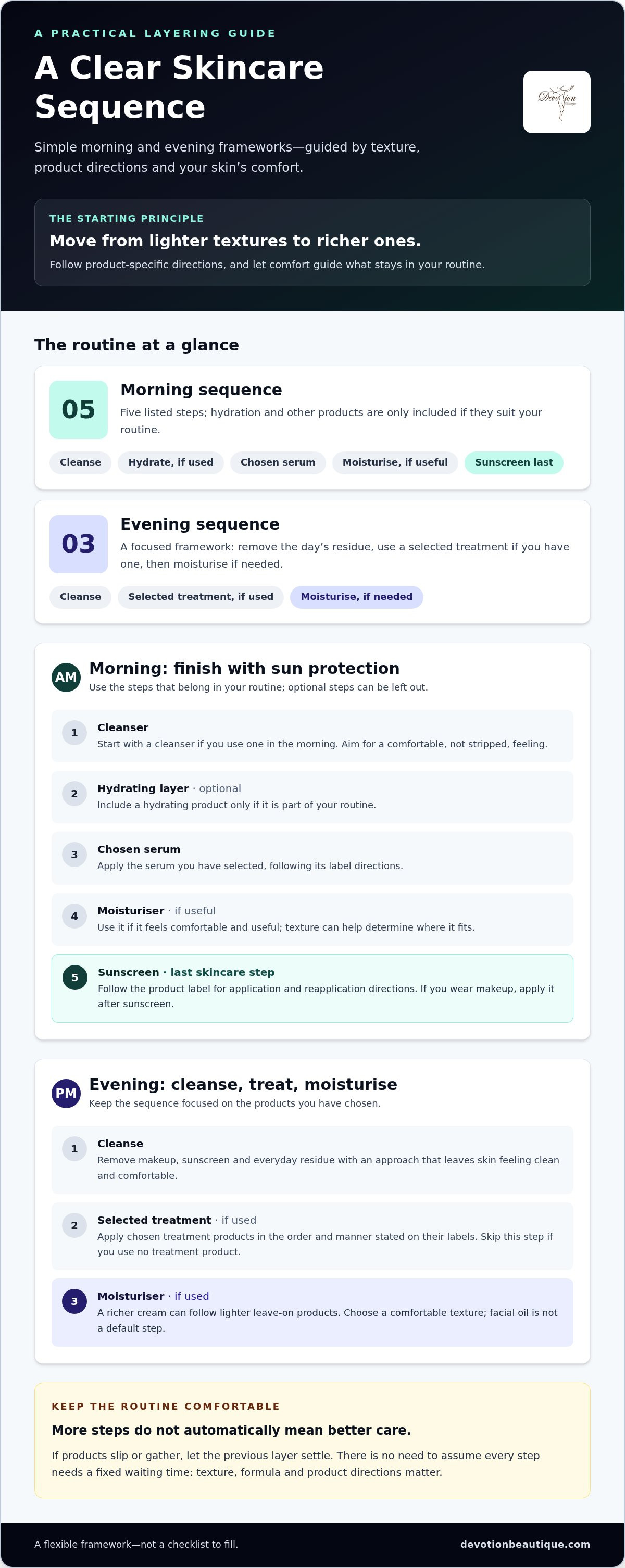
A considered routine doesn’t need to be complicated. Apply the products you use in a practical sequence, generally moving from lighter textures to richer ones, and let your skin’s comfort guide what stays in the routine. In the morning, sunscreen comes last. In the evening, focus on cleansing, any chosen treatment and moisture.
This guide sets out straightforward morning and evening routines, explains how to introduce active ingredients carefully, and shows when separating products may be more comfortable than using them together. You’ll also learn how to adapt the steps to your needs, so consistency matters more than the number of products on your shelf. This thoughtful approach to home care aligns with Devotion Beautique’s personalised facial programmes and curated skincare products.
Key Takeaways
- Learn how to layer skincare products correctly with a simple sequence that suits the products you use, without adding unnecessary steps.
- Build straightforward morning and evening routines around useful product categories, then adjust them to your preferences and skin’s comfort.
- Consider formulation, concentration and personal tolerance before combining active ingredients. Introduce changes gradually instead of relying on blanket rules.
- If your skin feels uncomfortable, pause recently added products and return to familiar basics while you observe how your skin responds.
- Let consistency guide your choices. A thoughtful routine can support your individual skin goals without becoming complicated.
Why the Order of Skincare Products Matters, and the Simple Rule to Start With
If one guide says to apply a product first and another recommends saving it for later, it’s understandable to feel unsure. Skincare advice can turn a simple routine into a long checklist, as if every product category needs a place on your bathroom shelf. It doesn’t. Skincare layering means applying the products you’ve chosen in a considered sequence, not using every type of product available.
Order can affect how products spread and sit together. A lightweight serum, for instance, may be easier to distribute before a richer cream than over a layer that feels oily or heavy. A considered sequence can also make a routine feel more comfortable and manageable. But order has limits: applying a product at the “right” point won’t make it suitable for your skin if it causes discomfort or doesn’t meet your needs.
Skincare products sit within the wider category of Cosmetics, which includes preparations with different uses and textures. That variety helps explain why no single sequence fits every product or routine. Product-specific directions matter, too. If a label gives instructions about when or how to apply a formula, follow those directions rather than relying on a general layering rule.
Does skincare order change how products sit on the skin?
Yes, it can change the feel and finish of a routine. A thoughtful order may help products spread more evenly and reduce the chance of pilling or a heavy finish. If products slip or gather, give the previous layer a moment to settle. There’s no need to assume every step requires a set waiting time: texture, formula and product directions all matter.
Think of the sequence as a helpful framework, not a guarantee that products will work well together. A product that feels uncomfortable may still feel that way wherever it appears in your routine. Pay attention to your skin’s response, and follow a product’s own instructions when they differ from general advice.
The beginner’s rule: start simple and layer by texture
A short routine is a practical place to begin, not a prescription for everyone. You might start with cleansing, one chosen treatment product and moisturiser, then decide whether another step has a clear purpose. There’s no need to add a toner, essence, serum, oil and cream simply because each category exists.
The basic layering principle is to apply products from lighter textures to richer ones, while following product-specific directions and your skin’s comfort. Fluid formulas often spread easily before thicker creams or oils. But texture isn’t the whole story: a gel may feel light while its directions call for a particular application method. Choose an order that lets your products sit comfortably together. More steps don’t automatically mean better care; a consistent, considered routine is a stronger starting point than a crowded one.
How to Layer Skincare Products in a Morning and Evening Routine
A useful routine should be easy to repeat, not a checklist that makes every product category feel essential. Treat these sequences as flexible frameworks: leave out steps you don’t use or need, and follow the directions on each product’s label. In the morning, sunscreen has a distinct role, so it stays as the final skincare step.
A straightforward morning skincare order
Build your morning routine around cleansing, any treatment or hydration you choose, moisturiser and sun protection. Follow the sequence below, skipping optional steps that don’t belong in your routine.
- Cleanser: Start with a cleanser if you use one in the morning. Choose an approach that leaves your skin feeling comfortable rather than stripped.
- Hydrating layer, optional: Apply a hydrating product if it’s part of your routine. This step isn’t essential.
- Chosen serum: Apply the serum you’ve selected, following its label directions.
- Moisturiser: Use moisturiser if it’s comfortable and useful for you. Its texture can help you decide where it fits among your other leave-on products.
- Sunscreen: Finish your skincare sequence with sunscreen. It has a daytime role in protecting skin from sun exposure, while the other steps focus on cleansing, treatment or moisture. Follow the product label for application and reapplication directions. If you wear makeup, apply it after your sunscreen.
This is a flexible framework, not a minimum number of steps to fill. If you don’t use a hydrating layer or serum, simply leave it out. Keep sunscreen last in your skincare routine, and let its own directions guide its use.
A straightforward evening skincare order
Evening care can be just as considered: cleanse, apply any selected treatment product, then moisturise if you use it. The aim is to remove the day’s residue and apply the products you’ve chosen, without adding steps for the sake of a longer routine.
- Cleanse: Cleanse your skin to remove makeup, sunscreen and everyday residue. Choose an approach that leaves your skin feeling clean and comfortable.
- Selected treatment: Apply the treatment products you’ve chosen, following the order and directions on their labels. Skip this step if no treatment product is part of your routine.
- Moisturiser: Finish with moisturiser if you use one. A richer cream can follow lighter leave-on products. Choose a texture that feels comfortable rather than adding facial oil by default.
Morning: cleanse, treat if desired, moisturise if needed, then sunscreen. Evening: cleanse, apply selected treatment if used, then moisturise if needed. This simple contrast makes it easier to remember how to layer skincare products correctly without turning your routine into a long sequence. For home care shaped around individual skin goals, explore Devotion Beautique’s curated skincare products.
How to Combine Active Ingredients Without Following Internet Myths
Ingredient-pairing advice online can sound absolute: use two ingredients together and your skin will react, or one will cancel out the other. In practice, compatibility depends on the specific formulations, their concentrations, how often you use them and your skin’s tolerance. A familiar ingredient name alone doesn’t tell you how two finished products will behave together.
No ingredient-pairing rule fits every formulation, concentration or skin, so let product directions and your own response guide the decision. Use the table as a cautious starting point, not a list of universal bans.
| Combination | General consideration |
|---|---|
| Exfoliating acids and retinoids | Using both in one routine may feel irritating for some people, especially when either product is strong or new. Consider separating their use. |
| Vitamin C and niacinamide | Some formulas are designed to be used together. If separate products cause discomfort, try using them at different times or follow their labels. |
| Retinoids and benzoyl peroxide | Check both products’ directions and consider whether the combination feels drying or irritating. Don’t assume every formula behaves the same way. |
When should active ingredients be used cautiously together?
Take particular care if you’re considering combining exfoliating acids, such as AHAs or BHAs, with a retinoid in the same routine. Both may be active treatments, and layering them could feel too intense for some skin. That doesn’t mean they’re automatically incompatible for everyone. Formulation, concentration, directions and personal tolerance all matter.
Let product labels guide use rather than viral pairing rules. If a product instructs you to use it on its own or at a particular frequency, follow that advice. If you’re uncertain, a cautious option is to use the products at different times, such as on alternate evenings, rather than layering them together. Don’t assume one ingredient deactivates another unless reliable product-specific information supports that claim.
How can you introduce a new active ingredient thoughtfully?
Change one thing at a time. Start with one unfamiliar active, follow its label directions and keep the rest of your routine familiar. If you introduce several new products together, it becomes harder to tell which one may be behind a change in how your skin feels. Avoid increasing use or adding another active at the same time to speed up results.
Pay attention to signs of discomfort, such as persistent stinging, redness or unusual dryness. If you notice a reaction, pause the new product and return to familiar basics while you observe your skin. Don’t try to push through ongoing irritation. Seek appropriate professional advice if a reaction is persistent, severe or concerning. Learning how to layer skincare products correctly includes knowing when to simplify, not just which products to combine.
How to Adjust Your Skincare Layers When Your Skin Feels Uncomfortable
If your skin starts feeling uncomfortable after a routine change, treat it as a reason to pause and observe, not as a diagnosis. The cause isn’t always obvious: a new product, the way it’s used or several changes at once may all be relevant. You don’t need to add another product to solve the uncertainty. Simplify first.
A short reset can help you see how your familiar routine feels:
- Pause recently added products, especially those introduced shortly before the discomfort began.
- Return to familiar basics that you already know feel comfortable, keeping the routine uncomplicated.
- Review each paused product’s directions before deciding whether or how to use it again.
- Observe your skin without changing several other parts of your routine at the same time.
This approach doesn’t promise that a routine adjustment will resolve a reaction. It gives you a clearer picture of what you’ve been using and how your skin responds. For more context on the skin barrier and sensitive skin, explore this sensitive-skin pH and barrier guide.
What to do when a new layer causes discomfort
A brief unfamiliar sensation and persistent discomfort aren’t the same experience, but it can be difficult to judge what’s happening from sensation alone. Don’t assume stinging or redness is a normal adjustment period. If a product causes ongoing or worsening discomfort, stop using it and review its directions. Avoid adding other active products in an attempt to counteract the reaction.
Seek appropriate professional advice if symptoms are severe, persistent or concerning, or if you’re unsure how to proceed. A skincare routine can be adjusted thoughtfully, but it can’t diagnose the reason for a reaction.
How to build a routine gradually and observe changes
Once your routine feels settled, make changes one at a time. Introduce one new product while keeping your other familiar steps consistent. Follow the label directions, and give yourself enough time to notice whether the product feels comfortable and manageable in your usual routine. Avoid changing the product, order and frequency all at once; otherwise, it’s harder to identify what may have influenced your skin’s response.
A brief routine log can make this process clearer. Note the product, when you used it, where it sat in your sequence and what you observed afterward. Record simple details, such as whether your skin felt comfortable or unusually dry. You’re gathering observations, not trying to diagnose a condition.
Learning how to layer skincare products correctly includes knowing when to pause and reassess. For considered home-care choices shaped around individual skin goals, explore Devotion Beautique’s curated skincare products.
Make Skincare Layering Part of a Personalised Home-Care Routine
A routine works best when it fits your skin goals and the rhythm of your day. The aim isn’t to collect more steps, but to choose products with a clear purpose and use them consistently enough to understand how they feel on your skin. A simple routine can change over time as your priorities shift.
Before adding a layer, consider what you want your home care to support. You might want more hydration, a carefully chosen treatment step or fewer products because your skin feels easily unsettled. Those priorities can guide product selection and sequence. If a product doesn’t serve a clear need or fit comfortably, it doesn’t have to stay in your routine simply because it’s popular.
Home care can sit alongside professional skincare as part of a broader approach to your skin goals. Let your needs, product directions and your skin’s response guide your choices. Learning how to layer skincare products correctly is part of building a routine that feels considered and sustainable, not a reason to keep adding steps.
When is a personalised skincare perspective useful?
A personalised perspective may be helpful when you’re unsure which home-care steps are relevant or when your priorities don’t fit a generic routine. Someone focused on hydration may choose different products from someone seeking a targeted treatment step. The sequence still needs to feel manageable, and no routine should be treated as a promise of a particular result.
Devotion Beautique’s personalised facial programmes include Relaxation, Remedial and ReProgram options. Founder Karen Goh brings 31 years of experience to the brand’s approach to individual skin goals. A facial programme can complement thoughtful home care by giving your skin priorities a more personalised context, while your everyday routine remains simple and consistent.
A gentle next step for refining your routine
Review your routine from time to time, especially if your needs or the way your skin feels have changed. Ask yourself whether each product has a purpose, whether the order is easy to follow and whether the routine feels comfortable enough to maintain. If you’re considering a new product, choose it for a specific need rather than adding several layers at once. Small, deliberate adjustments make it easier to notice what suits you.
Devotion Beautique offers curated skincare products for different skin concerns, giving you options to consider in light of your routine’s needs. Keep your choices focused: one suitable addition may be more useful than a larger stack. Let consistency, comfort and your personal goals shape the routine you return to each day.
If you’d like to explore thoughtful skincare and personalised facial care, explore Devotion Beautique.
Let Your Routine Evolve With Your Skin
Your skincare routine doesn’t need to be perfected in a single day. Choose one priority for the next few weeks, whether that’s keeping your routine comfortable, making a treatment step easier to follow or finding products that suit your needs. Give yourself space to notice how each choice feels before making another change.
This steady approach makes it easier to understand how to layer skincare products correctly for your own routine, rather than simply copying someone else’s steps. Your needs may shift over time, and your home care can shift with them. Thoughtful choices, made at a comfortable pace, are a meaningful way to care for your skin.
For support in exploring options aligned with your individual goals, explore Devotion Beautique’s curated skincare and personalised facial programmes. Take the next step gently and build a routine you feel good returning to.
Frequently Asked Questions
Should I apply skincare to damp or dry skin?
Follow the product’s directions, since the preferred skin surface can vary by formula. A hydrating product may be intended for slightly damp skin, while some treatment products direct application to clean, dry skin. If a label doesn’t specify, use the texture and your comfort as a guide. Avoid applying products to skin that’s still wet if they spread unevenly or sting. Pat gently rather than rubbing.
Can I use more than one serum in the same routine?
Yes, if each serum suits your routine and their directions allow it, but using several isn’t automatically more helpful. For example, you might choose one serum for hydration and another for a separate concern, then check whether their labels give a preferred order. Add only one unfamiliar serum at a time. If the combination feels uncomfortable or starts to pill, simplify and reassess.
What should I do if my skincare products start to pill?
If products roll into little flakes or balls, try using less of each layer and applying it with gentle, even strokes instead of rubbing repeatedly. Give the previous layer time to settle, and check whether the products are intended to be used together. Pilling can also happen when several layers are applied quickly. If it continues, remove an optional step and see whether the finish improves.
Is it okay to apply a facial mist between skincare layers?
Yes, a facial mist can be used between layers if its directions suit your routine, but it isn’t essential. For example, you could mist after cleansing, then apply your next product as directed. Avoid spraying so much that your face is dripping, since a very wet surface may affect how some products spread. If the mist leaves your skin sticky or uncomfortable, leave it out.
Can I use the same skincare routine in the morning and at night?
You can keep some familiar steps the same, but the routines don’t have to match exactly. For example, sunscreen belongs in your daytime routine, while at night you’ll want to cleanse away sunscreen and makeup. You may also choose different treatment products for each time of day, following their labels. A comfortable core routine can stay consistent while these specific steps vary.
How should I layer skincare around a spot treatment?
Use the spot treatment according to its label, since instructions differ by formula. Some are designed for clean skin, while others may fit later in your routine. Apply it only to the intended area and avoid spreading it across your face unless the directions say to. If you’re using other treatment products on the same spot, don’t assume they’ll work well together. Simplify if the area becomes uncomfortable.
