
Professional Bacne Facial for Deep Cleansing and Exfoliation
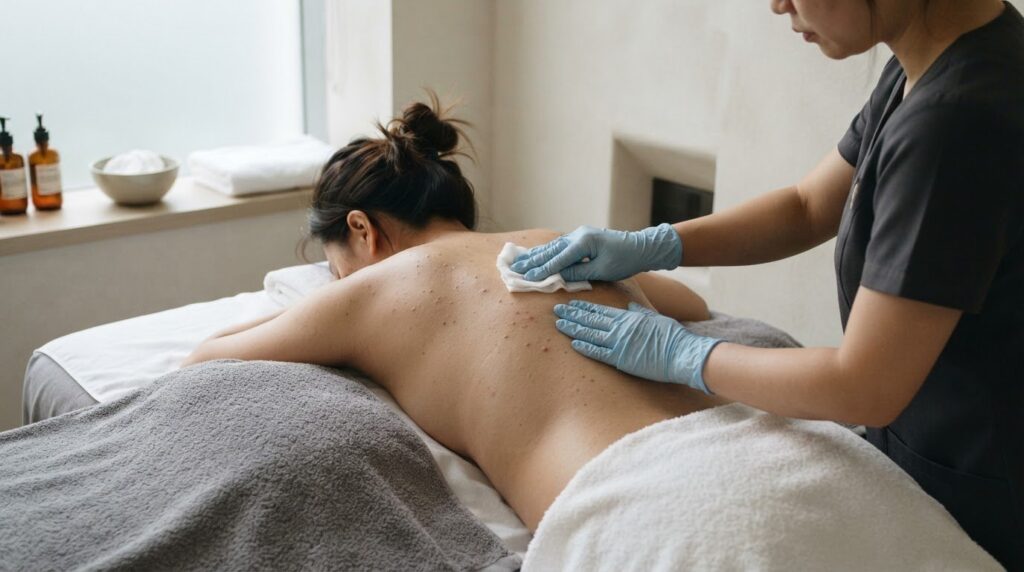
What if stubborn back breakouts need a more tailored approach than a regular cleanse? A professional bacne facial is a skin treatment focused on deep cleansing and exfoliation, with steps such as extractions or calming treatments chosen to suit the skin. It may be suitable for minor, non-severe acne, while persistent or more severe breakouts call for medical advice.
Back blemishes can range from blackheads and whiteheads to red, tender spots, so the right treatment approach matters. A careful assessment helps identify what your skin needs and whether a facial is an appropriate part of your care.
This guide explains what a back acne facial may involve, how treatment can differ by blemish type and what to look for in a provider. You’ll also learn what short-term changes and longer-term progress may look like, so you can make an informed choice for your skin.
Key Takeaways
- Learn how a facial assessment helps match treatment to the type of blemishes, skin condition and past care.
- See how deep cleansing and exfoliation may be combined with other professional approaches for back acne.
- Understand why one session may not resolve acne long term, and what short-term skin changes can follow treatment.
- Compare chemical peels, extractions, LED therapy and laser treatments by the concerns they address.
- Discover what can influence treatment costs in Singapore and how to decide when professional skincare or medical advice is the better next step.
What Is an Acne Facial Treatment?
An acne facial is a professional skin treatment that combines cleansing with steps suited to the blemish type and skin condition. For back acne, the therapist assesses active spots, blocked pores, sensitivity and related skin changes before choosing appropriate treatment components.
Consultation, Treatment Plans, and Cost
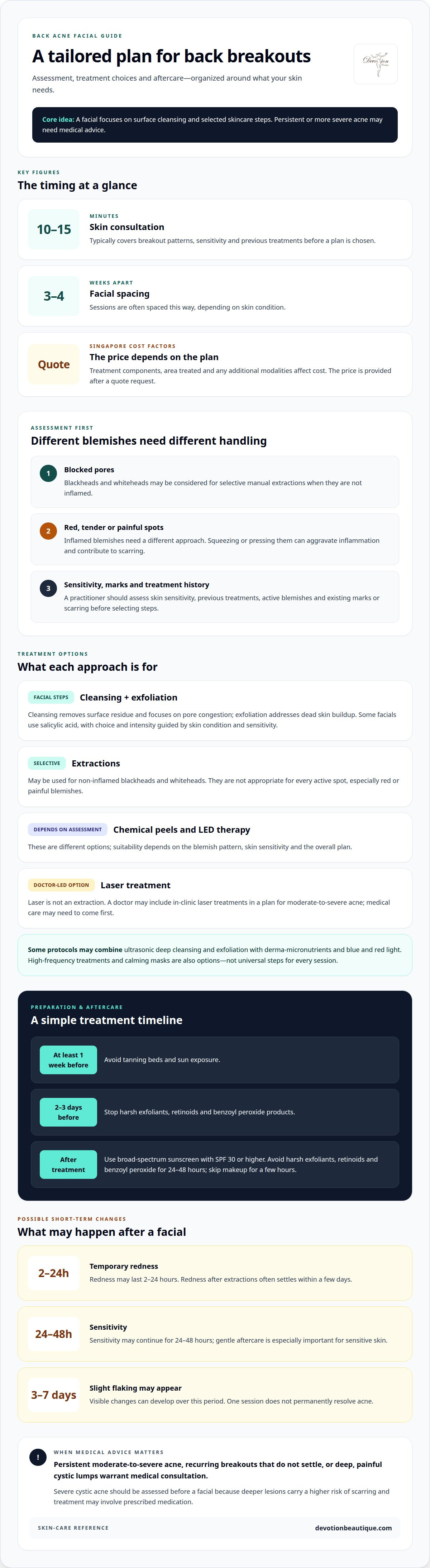
A skin consultation typically takes 10-15 minutes and covers the pattern of breakouts, skin sensitivity and previous treatments. Blackheads and whiteheads differ from red, tender papules or pustules, so the plan should reflect what is present rather than apply the same steps to every back. Existing marks or scarring also matter when selecting a treatment approach.
In Singapore, the cost depends on the treatment components, the area treated and whether additional modalities are included; the price is provided after a quote request. A useful plan explains which steps address congestion, active blemishes or post-acne changes, and how they fit with skincare at home or medical care. Facials are often spaced 3-4 weeks apart, depending on skin condition.
Suitability for Sensitive or Active Acne
Both sensitivity and active acne affect treatment suitability. Before choosing cleansing, exfoliation or extractions, a facial therapist should consider your current skin condition, the type and severity of blemishes, and your previous treatment history. Inflamed, tender spots need a different approach from non-inflamed blackheads. Squeezing active lesions can increase inflammation and scarring.
When should bacne be assessed by a doctor rather than a facial therapist? Persistent moderate-to-severe acne, recurring breakouts that do not settle, or deep, painful cystic lumps warrant medical consultation. Severe cystic acne should be assessed before a facial because deeper lesions carry a higher risk of scarring and treatment may involve prescribed medication.
Comparing Bacne Treatment Options
Extractions can clear non-inflamed blockages such as blackheads and whiteheads, but are not suitable for every active spot. Chemical peels and LED therapy are different treatment options; their suitability depends on the blemish pattern, skin sensitivity and overall plan. A careful assessment matters more than choosing a treatment by name alone.
Laser treatment is not another type of extraction. A doctor may include in-clinic laser treatments in a plan for moderate-to-severe acne, while a facial focuses on surface cleansing and selected skincare steps. Ask how each proposed option relates to active acne, marks or scarring, and whether medical care should come first.
Preparation, Aftercare, and Possible Risks
Before an acne facial, avoid tanning beds and sun exposure for at least one week, and stop harsh exfoliants, retinoids and benzoyl peroxide products 2-3 days beforehand. After treatment, use broad-spectrum sunscreen with SPF 30 or higher; avoid harsh exfoliants, retinoids and benzoyl peroxide for 24-48 hours. Skip makeup for a few hours so the skin can recover.
What are the risks and side effects of back acne facials? Temporary redness can last 2-24 hours, sensitivity may continue for 24-48 hours, and slight flaking can appear 3-7 days after treatment. Redness following extractions often settles within a few days. These changes make gentle aftercare important, especially for sensitive skin.
Deep cleansing and exfoliation
A back facial starts with cleansing to remove surface residue before exfoliation or other steps. The therapist assesses where blackheads, whiteheads or inflamed blemishes appear. This distinction matters: blackheads and whiteheads are blocked pores, while red, tender spots signal inflammation. A professional bacne facial should be tailored to these visible differences rather than treating the whole back as one uniform area.
Exfoliation helps address dead skin buildup on the surface, while deep cleansing focuses on pore congestion. Some acne facials use salicylic acid, a professional exfoliating ingredient, alongside cleansing. The choice and intensity depend on your skin condition and sensitivity. A back with non-inflamed blackheads, for example, calls for different extraction considerations from one with tender pustules. A consultation allows the therapist to assess these features before treatment.
Manual extractions may be used for non-inflamed blockages, including blackheads and whiteheads. They are not a reason to squeeze red or painful blemishes. Pressing inflamed spots can aggravate irritation and contribute to scarring. A careful practitioner distinguishes extractable congestion from active inflammation and adapts the facial accordingly. This selective approach is especially relevant on the back, where blemishes can appear at different stages at once.
Some professional acne facials combine cleansing and exfoliation with other modalities. One described medical-grade approach uses ultrasonic deep cleansing and exfoliation, followed by derma-micronutrients and blue and red light. The steps have different roles in the sequence: cleansing and exfoliation address surface buildup, while the later steps form part of the wider treatment. This is not a universal formula; the practitioner assesses whether it suits your skin condition.
Some acne facial protocols also use high-frequency treatments and calming masks. These are options within a treatment plan, not essential parts of every session. For sensitive skin, the therapist should account for existing irritation and active lesions when selecting products and techniques. A consultation should clarify the planned steps and how they relate to your blemishes.
Deep cleansing can support a broader skincare plan, but one session does not permanently resolve acne. Persistent or more severe breakouts may require professional facial care alongside medical treatment. A planned course can also be adjusted as your skin changes between visits. The focus should be a measured sequence: assess the back, choose suitable cleansing and exfoliation, and avoid aggressive treatment of inflamed areas.
Expected short-term and long-term results
After an acne facial treatment, visible changes may develop over 3-7 days. The back’s appearance can be assessed for changes in clogged pores, active blemishes and surface texture. Results vary with the skin type, the number of inflamed spots and the treatment steps used. A single session won’t permanently address acne, so immediate changes should be viewed as one part of ongoing care.
Some short-term effects are part of the skin’s response to treatment. Redness after extractions often subsides within a few days, while temporary redness after a facial treatment may last 2-24 hours. Slight flaking can appear 3-7 days after treatment. Skin may also feel more sensitive for 24-48 hours, so gentle aftercare matters during this period.
How many back acne facial sessions are usually needed, and how far apart? A facial is commonly scheduled every 3-4 weeks, depending on the skin condition. There isn’t one session count that suits every person: the number of visits depends on how the back responds, whether new blemishes appear and whether acne treatment is also underway.
Judge longer-term progress across multiple visits rather than immediately after one appointment. A practitioner can compare active blemishes, congestion and texture over time, then adjust the approach as your skin changes. For example, fewer blocked pores but continuing inflamed spots may call for a different plan from persistent congestion without tenderness.
Ongoing acne care may combine professional facials, suitable home skincare and medical advice. A doctor should assess persistent moderate-to-severe acne, which may require medicated lotions or antibiotics. Deep, painful cystic lesions also warrant medical consultation before a facial. A facial can support care for some blemishes, but it does not replace medical acne treatment when that is needed.
Track the same areas of your back between appointments to set practical expectations. Note changes in blackheads, whiteheads or red spots, and whether redness or sensitivity follows a session. This makes your next review more useful than relying on a single impression. A steady plan adjusted to your skin type and response offers a clearer way to assess progress than expecting lasting change after one treatment.
How much does a professional back acne facial cost in Singapore?
The price of a professional back acne facial in Singapore depends on the case and is provided after a quote request. Key cost factors include the treatment area, skin condition, steps involved and any additional modalities. A cleansing-focused session differs from one that includes exfoliation, extractions or light therapy. The treatment plan, not the label alone, shapes the quote.
The area being treated is one consideration. A facial covering the full back involves a different treatment area from one focused on a smaller region with congestion or active blemishes. The distribution of blackheads, whiteheads and inflamed spots also affects which steps are selected. During consultation, a practitioner assesses these features and determines which parts of the treatment are relevant to your concern.
The procedure also affects the quote. Deep cleansing and exfoliation are one approach; extractions address non-inflamed blockages, while LED therapy or a chemical peel adds a different treatment component. These methods are not interchangeable. Suitability depends on your skin condition, sensitivity and acne pattern. A plan combining approaches may involve different steps from a straightforward cleansing session.
Ask for a clear breakdown of what the proposed session includes. The quote should explain whether it covers consultation, cleansing, exfoliation, extractions, a mask or another modality. It should also clarify whether the treatment is for the full back or a specific area. These details help you compare equivalent services instead of judging by the treatment name alone.
Frequency matters when considering the overall commitment. Acne facials are commonly scheduled every 3-4 weeks, depending on the skin condition, but the appropriate plan varies. Persistent or moderate-to-severe acne can require medical care alongside facials, which changes the role of a cosmetic treatment. A session should not be treated as a substitute for medical assessment when breakouts are persistent or painful.
For a practical decision, connect each cost factor to a clear treatment purpose. If blackheads are your main concern, ask which steps address non-inflamed congestion. If redness, tenderness or scarring is present, the plan should account for those changes rather than simply adding procedures. In Singapore, a useful quote explains the treatment area, selected steps and the reason for each component. This gives you a more meaningful basis for evaluating the proposed care.
These figures offer broad benchmarks, not a guaranteed quote for a back-specific plan, as the final amount still depends on the selected treatment area and steps.
These general categories may overlap with acne facial pricing, so compare the actual inclusions rather than assuming a higher category means a more suitable option. Before booking, check that the quoted amount matches the service described and ask whether recommended add-ons are included or priced separately.
How do chemical peels, extractions, LED therapy and laser treatments compare for bacne?
These approaches have different roles in acne care. Chemical peels, extractions and LED therapy may be part of facial treatment plans, while a doctor may include in-clinic laser treatment for moderate-to-severe acne. Compare options by considering the blemishes present, their severity and your skin’s sensitivity. No single modality suits every back or breakout pattern.
Chemical peels are distinct from manual extractions. Their role in a plan depends on your skin condition and the practitioner’s assessment. A back with scattered congestion raises different considerations from skin with widespread tenderness or irritation. Ask what concern a proposed peel is intended to address and how it fits with other steps. The label alone does not tell you whether it suits your skin.
Extractions target non-inflamed blockages, including blackheads and whiteheads. They are not a treatment for every visible spot: red, swollen or tender blemishes are inflamed, not simple blockages. For example, a back with blackheads alongside painful bumps needs selective assessment. The practitioner should identify which areas are suitable for extraction instead of using the same technique across the whole treatment area.
LED therapy may be included alongside other facial steps. One medical-grade acne facial approach combines ultrasonic deep cleansing and exfoliation with derma-micronutrients, followed by blue and red light. This describes a combined protocol, not a universal sequence or a guarantee of results. If LED is proposed, ask how it relates to your skin condition and whether it complements the other planned components.
Laser treatment has a different role in care. A doctor may include in-clinic laser treatments in a plan for moderate-to-severe acne. Medical assessment is especially relevant for persistent, painful or extensive breakouts. Laser is not another extraction technique, and a facial therapist’s surface treatment does not replace medical care when acne is more severe.
Compare options by matching each to a specific concern: non-inflamed blockages, active inflammation, sensitivity or persistent acne. Then consider whether the approach is a standalone step or part of a wider plan. Selective extractions, for example, may address blackheads, while continuing severe acne may require medical care. This distinction keeps treatment choices grounded in your skin’s presentation.
For a considered next step, discuss a personalised facial-care approach suited to your skin goals.
An acne facial is described as providing deeper skin cleansing than is difficult to reproduce at home, and may include extractions and higher-grade skin treatments.
The page also describes acne facials as using deep pore cleansing with salicylic acid, professional extractions, high-frequency treatments, and calming masks. It gives an example of bi-weekly corrective facial treatments during weeks 1-8. These details can help clarify what a proposed facial includes and how a course may be structured.
Devotion Beautique
Devotion Beautique offers personalised facial care for people seeking a considered approach to their skin goals. Its ReProgram Facial and Remedial Facial support targeted skincare needs, with treatment choices guided by individual concerns and skin condition. For back blemishes, this can be a natural next step when you want to discuss how facial care may fit into a broader routine. Persistent or severe acne, painful cysts, or possible scarring call for medical advice rather than relying on a facial alone. A tailored conversation can help clarify which aesthetic care aligns with your goals and when medical treatment should take priority. For a personalised discussion about your skincare needs, contact Devotion Beautique.
Choose a Considered Next Step for Your Skin
A professional bacne facial can be one part of a considered approach to back skin, not a quick fix or complete solution on its own. Before proceeding, decide what you most want to address, such as recurring congestion, visible marks or overall skin comfort. This focus can help guide a discussion about suitable care and how it fits into your wider skincare routine.
Skin needs can change, so let your plan respond to what you notice over time. Keep the next step simple: describe your concerns, share what you have already tried and discuss an appropriate approach. If your acne is persistent or severe, medical guidance should remain central to your care.
For a personalised conversation about your skin goals, contact Devotion Beautique. A thoughtful plan begins with understanding your skin and choosing care with intention.
Frequently Asked Questions
What does a back acne facial involve?
A professional bacne facial is a back-focused skincare treatment tailored to your skin’s needs. At Devotion Beautique, the Bacial Series provides back detox and exfoliation. Other acne facial approaches may include cleansing, exfoliation, extractions or calming steps, depending on the treatment plan. Before booking, clarify which steps are included and whether they address your concern, such as congestion or uneven texture.
Who should avoid a bacne facial or consult a dermatologist first?
People with severe cystic acne should seek medical advice before having a facial. Deep, painful lumps can carry a higher risk of scarring, while persistent moderate-to-severe acne may require a doctor’s treatment plan. Acne-like bumps can also have another cause, so clinical assessment can help distinguish conditions. Tell the practitioner about your current symptoms and previous acne treatment before proceeding.
How can I choose a qualified provider for back acne treatment in Singapore?
Choose a provider who assesses your skin condition before recommending treatment and explains why each step suits your concerns. For example, ask how the plan distinguishes non-inflamed blockages from tender, active spots and what aftercare it involves. A provider should also recognise when persistent or severe acne needs medical assessment. For a professional bacne facial, clear explanations help you understand the proposed care before you decide.