
Which Facial Should You Get Before a Major Event?
The best facial before a major event is often the gentlest one your skin already knows. Schedule most professional facials 10–14 days ahead, and leave at least two weeks before an important event to try a new treatment. With only 24–48 hours to go, choose a gentle, calming or hydrating facial rather than a treatment likely to irritate your skin.
It’s natural to want a quick refresh before a celebration, wedding, or photoshoot. But trying an unfamiliar treatment to tackle a sudden breakout or redness can add stress when your skin needs calm, considered care.
Here, you’ll learn how to choose a facial based on your timing and skin goals, plan your first treatment, and care for your skin in the final days. We’ll also cover what to avoid and how professional guidance can help if a last-minute concern changes your plans.
Key Takeaways
- Choose treatment timing around your event date, skin sensitivity and familiarity with the facial, not just the glow you hope to achieve.
- For a first facial, plan ahead so you can see how your skin responds before the occasion.
- Keep your routine gentle and familiar in the final days, and avoid experimenting with strong products or treatments.
- If a last-minute breakout or irritation appears, resist the urge to treat it aggressively yourself; professional guidance can help you choose a calmer next step.
- Match the treatment to your skin goals, whether you’re seeking targeted correction, soothing care or a refreshed appearance.
1. So, Which Facial Should You Get Before a Big Event?
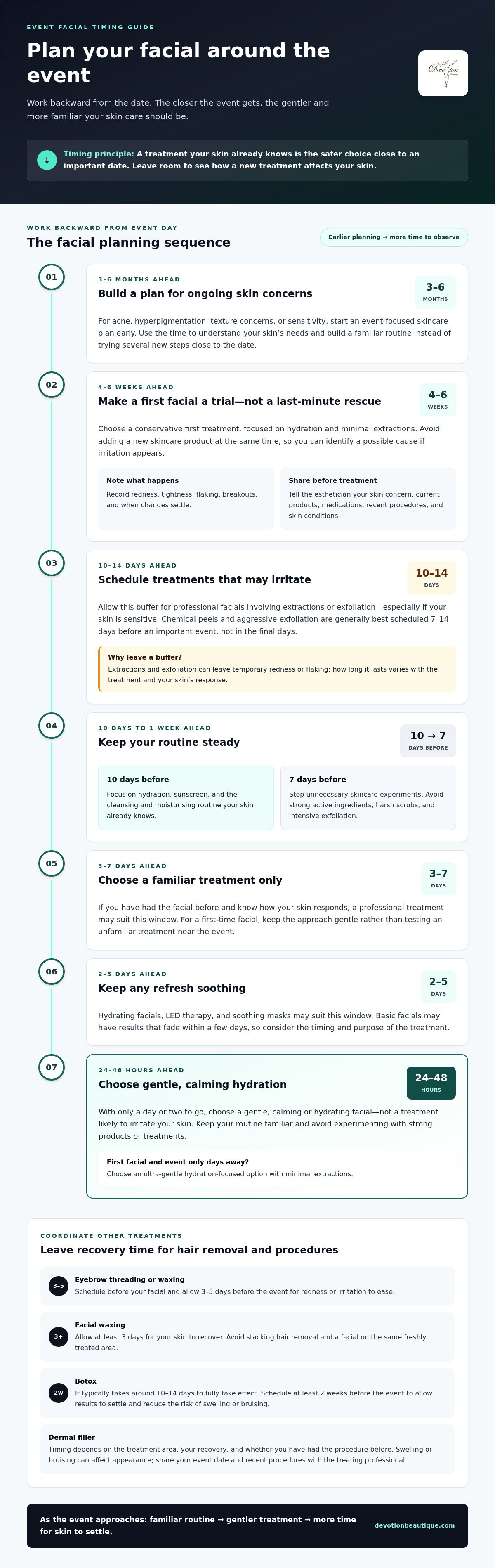
A facial before a major event should match your skin’s history and the time remaining. For a wedding, aim for 10–14 days beforehand if the treatment may involve extractions or exfoliation. If you’ve had that facial before and know how your skin responds, a professional treatment may suit the 3–7 days before the event. Choose gentle, calming hydration 24–48 hours beforehand instead.
Trying a facial for the first time? Leave at least two weeks before the occasion, especially if your skin is sensitive or reactive. A new product or technique can trigger irritation, redness, or breakouts. Close to the date, a familiar facial is a safer choice because you already know how your skin responds.
At-home facials work well for familiar, gentle steps, such as applying a hydrating mask. For extractions or exfoliation, a professional can tailor the facial to your skin. If the event is only days away and you’re new to facials, choose an ultra-gentle option focused on hydration, with minimal extractions.
Schedule eyebrow threading, eyebrow waxing, or facial waxing before your facial, not after. Allow 3–5 days before the event for redness or irritation from eyebrow hair removal to ease. After facial waxing, allow at least 3 days for your skin to recover. Avoid stacking hair removal and a facial on the same freshly treated area.
Dermal filler timing depends on the treatment area, your recovery, and whether you’ve had the procedure before. Swelling or bruising can affect the area’s appearance, so allow recovery time rather than scheduling filler close to the event. Tell the treating professional your event date and about any recent procedures.
Botox typically takes around 10–14 days to fully take effect. Schedule it at least 2 weeks before the event to allow results to settle and reduce the risk of swelling or bruising. Share your event date and treatment history when planning.
How much does a facial cost in Singapore? The price depends on the treatment, your skin’s needs, and what the session involves. Request a quote for the treatment you’re considering.
How long does redness or irritation last after a facial? It varies with the treatment and your skin’s response; extractions and exfoliation can leave temporary redness or flaking. That’s why a 10–14-day buffer is prudent for sensitive skin.
Where can I book a reputable facial in Singapore? Book a professional facial through the Singapore clinic where you’re reading this article, choosing a treatment suited to your skin and event timing.
2. Planning a first facial before an event
Start early if this is your first facial and a special event is approaching. For acne, hyperpigmentation, texture concerns, or sensitivity, begin an event-focused skincare plan 3–6 months ahead. That gives you time to understand your skin’s needs and build a familiar routine, rather than trying several new steps close to the date.
Make the first appointment a trial, not a last-minute rescue. For a wedding or photoshoot, consider trying a facial in advance, then note how your skin looks and feels afterward. Record any redness, tightness, flaking, or breakouts, and share those observations before choosing another treatment.
Before your session, write down your main concern, such as dryness, uneven tone, or congestion. Bring the names of your current skincare products and describe what you use regularly. Tell the esthetician about medications, recent cosmetic procedures, and skin conditions, as these can affect treatment choice and timing.
If you’ve never had a facial, keep the first treatment conservative. A gentle approach focused on hydration and minimal extractions helps you understand how your skin responds, without combining unfamiliar techniques. Avoid introducing a new product at the same time, so you can identify a possible cause if irritation appears.
Event planning can be stressful, and a facial can offer a quiet pause in a packed schedule. Set aside time for your appointment rather than rushing straight from work or errands. A Relaxation Facial offers a calming experience, while your treatment plan should still reflect your skin goals and event date.
Considering Ultherapy as well? It is a separate aesthetic treatment, not a facial, so consider it as its own decision. Share your event date, treatment history, medications, and any skin conditions. The professional can explain suitability, expected recovery, and how its timing fits alongside other procedures.
After your trial, keep a simple treatment record: appointment date, products used, skin changes, and when those changes settled. This gives you useful details for planning your next session. If irritation persists or you have a strong reaction, pause new skincare experiments and seek appropriate professional advice.
For a first facial, the best plan is one that protects time for observation. Book the trial 4–6 weeks before the event, keep your routine familiar afterward, and use your notes to guide any later treatment. A considered schedule leaves room to respond to your skin, instead of making rushed changes as the occasion approaches.
3. Skincare routine in the final days before an event
Use the final stretch to protect your skin barrier, not overhaul your skincare. Ten days before a wedding or photoshoot, focus on hydration, sunscreen, and the routine your skin already knows. Keep cleansing and moisturising familiar, and don’t add a new serum just because it promises a fast glow.
Seven days before the event, stop unnecessary skincare experiments. Strong active ingredients, harsh scrubs, and intensive exfoliation can leave skin irritated when there’s little time to recover. Chemical peels and aggressive exfoliation are generally best scheduled 7–14 days before an important event, rather than in its final days.
For a final refresh, hydrating facials, LED therapy, and soothing masks may suit the 2–5 days before an event. Facial massage can boost circulation and encourage lymphatic drainage, which may reduce puffiness and improve skin tone. Basic facials may have results that fade within a few days, so consider timing and the treatment’s purpose.
Before and after a facial, keep your routine simple: arrive with clean skin and tell the professional which products you use. Afterward, follow the care advice you receive, cleanse gently, moisturise, and protect your skin with sunscreen. Avoid introducing new active ingredients while your skin settles.
For acne, hyperpigmentation, or uneven texture, build a longer skincare timeline instead of chasing rapid change. Start an event-focused plan 3–6 months ahead, with a consistent routine and treatments suited to your concerns. This gives you time to observe how your skin responds and adjust the plan before photographs or celebrations.
A trial facial 4–6 weeks before a major event can help you learn how your skin responds. Then schedule a gentle maintenance facial 3–7 days before, allowing time to notice any temporary changes. Keep notes on dryness, sensitivity, or breakouts after the trial, and share them when planning the final appointment.
If a breakout or redness appears close to the event, don’t try to fix it with harsh products or aggressive scrubbing. These can worsen irritation. Stick to your established routine, and seek professional advice about a new or persistent concern rather than layering unfamiliar treatments.
- Ten days out: Prioritise hydration, sunscreen, and familiar products.
- Seven days out: Avoid unnecessary experiments and harsh exfoliation.
- Two to five days out: Consider a soothing refresh, such as hydration or LED therapy.
With only a few days left, avoid harsh treatments, scrubs, and strong active ingredients. Trying to fix a breakout or redness yourself may make irritation worse.
4. Treatments to avoid close to an event
In the final days before a wedding or photoshoot, avoid unfamiliar treatments that may leave temporary redness, flaking, or irritation. Extractions and exfoliation can bring underlying congestion to the surface, so a breakout may appear when you hoped for a clear complexion. Don’t try to correct it with a strong peel or extra scrubbing.
New treatments need a test window. Try an unfamiliar facial or product at least two weeks before the event, then observe how your skin responds. If you have sensitive or acne-prone skin, choose a gentle approach and schedule a facial at least 10–14 days ahead. Tell the professional about your skin history, medications, recent procedures, and past reactions before treatment selection.
Laser and other technology-based treatments also need advance planning. Their effects and recovery depend on the device, treatment intensity, skin concerns, and your response. Don’t book your first laser or technology-based treatment in the final days before an event. Discuss your event date and treatment history during consultation, and allow time to observe your skin before deciding on another session.
About one month before an event, you have more time to trial a custom facial, a peel you’ve had before, dermaplaning, or a hydration-focused facial. Familiarity matters: a treatment you’ve tolerated before is different from trying a new method. Note any redness, sensitivity, or flaking after your appointment, then keep the final days gentle.
A trial facial 4–6 weeks before a major occasion gives you time to assess your skin’s response. Record the treatment, products used, and any changes you notice afterward. Share those details at your next appointment. This history helps guide later choices and avoids repeating a treatment that caused an unwanted reaction.
Should you get a facial with sensitive or acne-prone skin? Yes, choose a gentle facial and schedule it at least 10–14 days before the event. Your skin history, current irritation, and previous reactions should guide the treatment choice.
For a simple decision, consider three factors: how soon the event is, whether you’ve tried the treatment before, and how your skin reacted. If the date is close and the treatment is new, avoid experimenting. Stick to familiar skincare and save corrective treatments for a longer-term plan.
If you’ve never had a facial, don’t make your wedding the occasion for your first one. Products that don’t suit your skin may cause a reaction. That possibility is reason enough to avoid taking the risk right before the wedding. Postponing your first facial means the event won’t be the moment you discover a product mismatch.
5. Professional help for last-minute skin concerns
A sudden breakout, patch of redness, or irritation can feel especially noticeable before photos. Note when it appeared, where it is, and what changed in your routine. This record helps a skincare professional distinguish a new concern from your usual pattern and avoid suggestions that conflict with recent treatments or products.
Until you receive guidance, resist squeezing blemishes or layering strong products. Picking can aggravate visible irritation, while unfamiliar exfoliants may cause more redness. Keep your usual gentle cleansing and moisturising routine, and pause recently introduced products if they seem connected to the change.
Share useful details during your appointment: when the concern began, products used, medications, skin conditions, and any recent cosmetic procedures. Bring product packaging or clear photos if you can’t recall an ingredient name. This information helps shape a treatment choice around your skin history, rather than a rushed attempt to change everything at once.
Timing matters. With 24–48 hours before an event, choose only a gentle, calming, or hydrating facial that isn’t expected to irritate. On the event day, keep treatments very gentle, such as a hydrating mask, LED light therapy, or lymphatic drainage massage. Avoid a new peel or intensive extraction as a last-minute fix.
If you have 2–5 days, hydrating facials, LED therapy, and soothing masks can serve as refresh treatments. Facial massage boosts circulation and encourages lymphatic drainage, which may reduce puffiness and improve skin tone. The key is to describe the concern clearly and choose a treatment that suits the remaining time, not simply the most intensive option.
If a breakout appears before your wedding, don’t use it as a reason to overhaul your routine. Keep your usual skincare steady, avoid harsh scrubs, and share the event date and any recent changes with the professional. If redness or flaking follows a facial, explain what was done and when, so the next step accounts for your skin’s response.
A professional facial can focus on calming, hydration, or a more targeted skin concern, depending on your needs and timing. For a personalised next step, explore facial care options and describe what has changed, what you’ve already tried, and when your event is coming. Clear details make it easier to choose a measured response and avoid stacking treatments close to the occasion.
Devotion Beautique: Advanced Aesthetic Series Skin Boosting RETREAT
Devotion Beautique’s Advanced Aesthetic Series Skin Boosting RETREAT offers a considered option for focused, ongoing skincare. If an upcoming occasion has brought hydration, brightness, or texture concerns into focus, a personalised facial programme can help shape a plan around your skin goals and treatment history.
For targeted correction, the ReProgram Facial or Remedial Facial may suit specific concerns. Share your event date, current skincare routine, and any recent reactions so your treatment can account for timing as well as your skin’s needs. If the event is close, discuss gentle options rather than adding an unfamiliar intensive treatment.
Contact Devotion Beautique to discuss the facial approach that best fits your skin concerns and event plans.
Make your event skincare plan personal
Let your next step reflect how you want your skin to feel, not only how you hope it will look in photographs. Choosing a facial before a major event is also an opportunity to understand your skin’s needs and build care that continues beyond the celebration. A focused conversation about your priorities, past reactions, and existing routine can help shape a thoughtful treatment plan.
If targeted correction is your priority, the ReProgram Facial may be an option to discuss. Share your event plans and skin concerns so the treatment approach supports your wider skincare goals, rather than becoming a last-minute experiment.
Devotion Beautique can help you consider a suitable facial approach for your needs. Contact Devotion Beautique for facial advice and take the next step with care and confidence.
Frequently Asked Questions
So, Which Facial Should You Get Before a Big Event?
Choose a facial based on your skin goal, treatment history, and event date. For comfort and nourishment, a gentle hydrating option may suit you; for a specific concern, a targeted treatment may be more appropriate when planned in advance. For example, tell the professional whether makeup needs to sit smoothly over dry areas, and mention any past sensitivity before choosing an approach.
What If I Only Have a Few Days Left?
Choose a familiar, gentle treatment, or skip the facial if your skin is already irritated. When time is short, avoid turning a small concern into several new steps. Stick to your usual cleanser and moisturiser, and don’t squeeze a breakout before a celebration. If you’re considering a treatment, explain exactly when the event is and describe any recent products or procedures so the plan can account for them.
How many days before a major event should I get a facial?
Consider allowing time for your skin to settle after a facial involving extractions or exfoliation. A familiar professional facial may suit the 3–7 days beforehand, while gentle hydration may fit 24–48 hours before. Sensitive skin benefits from the longer window. These timelines help you choose based on the treatment’s intensity and your past response, rather than assuming every facial needs the same recovery period.
Which facial is best before a wedding or special event?
The best choice depends on whether you want relaxation, skin maintenance, or targeted correction. A Relaxation Facial may suit you if you’re seeking a calming experience, while a Remedial Facial focuses on maintenance and specific concerns. For targeted skin goals and longer-term improvement, consider the ReProgram Facial. Match your choice to your skin history and schedule it early enough to observe your response before the wedding.
What facial treatments should I avoid before an important event?
Avoid unfamiliar or aggressive treatments close to the date, especially strong exfoliation, peels, or intensive extractions. They may cause temporary redness, flaking, or irritation, and congestion can surface after treatment. If you’ve never had a facial, don’t make the event week your first trial. Stick to established skincare, and plan corrective treatments for a time when your skin has room to settle.
Can I try a new facial treatment shortly before an event?
It’s better to try a new facial treatment at least two weeks before an important event. This gives you time to notice how your skin responds before photos, makeup, or celebrations. Introducing a new product alongside a new treatment can also complicate matters, so avoid changing several parts of your routine at once. Before an upcoming occasion, favour options you already know your skin tolerates.
