
AHA BHA Professional Peel Singapore: A Thoughtful Guide to Choosing

The strongest peel isn’t automatically the best choice for your skin. If you’re considering an AHA BHA professional peel Singapore, you may be wondering which acid suits your concerns, whether exfoliation could trigger irritation, and how a professional treatment differs from a retail product. A sensible starting point is your skin’s readiness, not the strength of the formula.
AHA and BHA have different roles in skincare formulations, and choosing between them depends on your skin’s condition, sensitivities and goals. This guide explains those roles, what suitability and aftercare involve, and how professional planning differs from using an at-home product. You’ll also find practical points to consider before deciding on a treatment approach.
At Devotion Beautique, personalised facial programmes are guided by individual skin goals and longer-term care. ReProgram focuses on targeted skin correction and long-term improvement, while Remedial supports maintenance and specific concerns. Knowing what you want to address can help you make a more considered choice, whether you’re exploring exfoliation or a broader approach to skincare.
Key Takeaways
- AHA and BHA have different roles in peel formulations. Relate those differences to your skin goals instead of assuming one is universally better.
- When considering an AHA BHA professional peel Singapore, focus on skin readiness and suitability, not just acid strength or percentage.
- Prepare for a treatment discussion by explaining your goals, current skincare routine and any sensitivity concerns.
- Follow guidance tailored to your treatment. Instructions for retail exfoliants aren’t universal aftercare advice.
- Consider a personalised facial programme, such as ReProgram for targeted skin correction and long-term improvement, as part of ongoing care.
AHA BHA Professional Peels in Singapore: What the Treatment Terms Mean
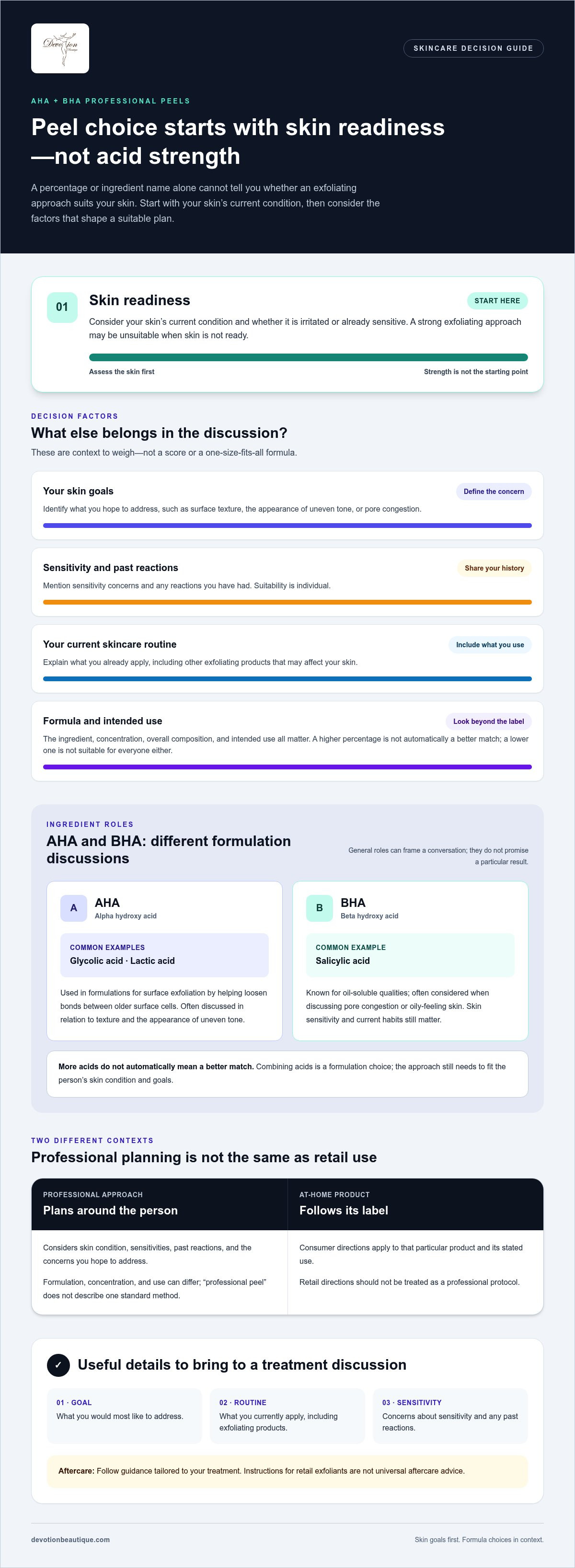
Choosing an at-home exfoliant starts with reading the product label and deciding whether it fits your routine. Professional peel planning starts with your skin: its current condition, sensitivities, past reactions and the concerns you hope to address. For anyone considering an AHA BHA professional peel Singapore, that distinction matters. The same acid category can appear in products intended for different uses.
Professional peel planning considers whether an exfoliating approach suits your skin and goals; retail exfoliation involves using a consumer product according to its label. A percentage on a package can’t, by itself, tell you whether an approach is suitable or predict how your skin will respond.
What do AHA and BHA mean in skincare?
AHA stands for alpha hydroxy acid, a family of acids used in skincare formulations. Glycolic acid and lactic acid are familiar examples. Broadly, AHAs are used to exfoliate the skin’s surface by helping loosen the bonds between older surface cells. Their role depends on the overall formula, not just the ingredient name.
BHA means beta hydroxy acid. Salicylic acid is a common example, included in some formulations for its oil-soluble qualities and role in addressing concerns such as congestion. These are general formulation roles, not promises of a particular result. This chemical peel overview also describes peels as treatments that use chemical solutions to exfoliate the skin, while noting that possible effects vary.
How is a professional peel different from an at-home acid product?
At home, the product label guides consumer use. A professional approach considers how a formulation and treatment plan relate to an individual’s skin and circumstances. “Professional peel” doesn’t describe one standard formula or method. The acids, their concentration and how they’re used can differ, so a retail product’s directions shouldn’t be treated as a professional protocol.
Concentration alone is an incomplete measure. The formula’s composition and intended use, along with the skin’s condition and sensitivity, all matter. A higher percentage isn’t automatically a better match. If your skin is irritated or already sensitive, a strong exfoliating approach may be unsuitable. A lower percentage doesn’t guarantee that a product will suit everyone either. Suitability is individual.
For example, seeing glycolic acid on a retail label doesn’t mean a professional approach should use the same acid, concentration or application instructions. A consumer product is formulated for its stated use; a treatment plan considers the person as well as the ingredient. Before deciding on a direction, share what you already apply, any past reactions and what you’d like to improve. Good planning starts with context, not a number on a bottle.
How AHA and BHA Formulations Address Different Skin Goals
AHA and BHA are ingredient families, not ready-made answers to a skin concern. Their general roles can help frame a discussion, but they don’t guarantee a particular outcome. The key question is how an approach fits your skin’s current condition, sensitivity and goals. That matters when comparing an AHA BHA professional peel Singapore with a formula chosen by its ingredient list alone.
Acid selection depends on your goals and skin readiness, not on which ingredient sounds stronger or more comprehensive.
Ingredient: AHA, including glycolic and lactic acid. Typical formulation role: Surface exfoliation, often discussed in relation to texture and the appearance of uneven tone. Discussion points: Current sensitivity, skin condition and the concern you want to address.
Ingredient: BHA, commonly represented by salicylic acid. Typical formulation role: Often considered when discussing pore congestion and oily-feeling skin. Discussion points: Sensitivity, current skincare habits and whether the approach fits your skin’s needs.
When might an AHA-focused approach be considered?
An AHA-focused approach may be discussed when the goal relates to surface texture or the appearance of uneven tone. Glycolic and lactic acid are examples in this family, but neither is a universal first choice or a guarantee of improvement. A professional considers the individual’s skin and circumstances before deciding whether an AHA approach is appropriate.
When might a BHA-focused approach be considered?
BHA may come up when someone is concerned about pore congestion or skin that feels oily. Salicylic acid is a familiar example, but its presence doesn’t guarantee clearer-looking pores or make a formula suitable for everyone. Skin sensitivity and current habits, including the use of other exfoliating products, are important parts of planning.
Combining acids is a formulation choice, not an automatic upgrade. A multi-acid formula may bring together ingredients with different roles, but more ingredients don’t necessarily mean a better match. The approach still needs to suit the person’s skin condition and goals. Likewise, the ingredient percentage alone can’t tell you whether a formula will suit you or how your skin may respond.
Before discussing an approach, identify the concern you’d most like to address, such as uneven-looking tone or congestion, and mention any sensitivity or products that seem to affect your skin. This gives the conversation a useful starting point without assuming a particular acid is the answer. A personalised approach to skin-focused facial care keeps individual goals at the centre of the decision.
Professional Peel or At-Home Exfoliant: Compare the Decision, Not Just the Strength
Professional guidance and retail exfoliants serve different needs. A retail product gives directions for using that particular formula; a professional discussion can consider how your skin goals and routine fit into a broader plan. Neither route is automatically right for everyone. Compare how each fits your circumstances, not which sounds more powerful.
| Decision factor | Professional guidance | Retail exfoliant |
|---|---|---|
| Personalisation | Skin goals and individual circumstances can inform the discussion. | You choose a product based on its description and your needs. |
| Routine fit | Existing products and recent exfoliation can be considered together. | Follow the product’s own directions and consider how it fits your routine. |
| Support | Planning can include discussion of sensitivity and past reactions. | Use the label as your guide; it isn’t a professional treatment protocol. |
What can professional planning add to a peel decision?
A considered plan starts with context: what you’d like to address, what you already use and how your skin has responded to exfoliation. Mention sensitivity, recent use of acids or other exfoliants, and previous reactions. These details keep the conversation focused on your skin rather than a percentage on a product label. When considering an AHA BHA professional peel Singapore, strength alone doesn’t establish suitability.
Explain how your routine fits into everyday life, too. If you already use an exfoliating product, that’s useful context when discussing another exfoliating approach. A higher percentage isn’t automatically a better choice, and a retail product’s instructions aren’t directions for a professional treatment. The aim is an informed decision that takes individual skin readiness into account.
When might a retail exfoliant fit better?
A retail exfoliant may suit someone looking for a consumer product to use independently according to its label. Read the directions carefully, and avoid layering unfamiliar exfoliants until you understand how they fit into the rest of your routine. If you’re reviewing how products work together, this professional skincare routine guide offers a relevant next step.
Retail use isn’t an inferior choice, and professional planning isn’t simply a stronger version of the same thing. They involve different forms of guidance. A product label applies to that product; it can’t tell you how a separate formula, professional treatment or combination of products will suit your skin. If you’re weighing longer-term care alongside a specific concern, explore personalised facial programmes.
What to Discuss Before and After a Professional AHA BHA Peel
A thoughtful peel discussion covers more than choosing an acid. Your goals, current skincare habits and history of sensitivity can all help shape the conversation. If you’re considering an AHA BHA professional peel Singapore, prepare a clear picture of how your skin behaves and what you hope to address. Then follow guidance specific to the treatment you receive.
What should you share before a peel discussion?
Be clear about your priorities, whether they relate to texture, uneven-looking tone or congestion. Mention sensitivity and previous reactions to skincare or exfoliation. Share your routine too, including current exfoliants and other active products, so the discussion reflects what your skin is already exposed to. Don’t diagnose a condition yourself or stop prescribed care without guidance from the professional responsible for it.
A simple sequence can help you prepare:
- Describe your goals. Explain what you’d like to improve and which concerns matter most to you.
- Share your routine. Include exfoliants and other active skincare products, not only cleanser and moisturiser.
- Discuss sensitivity. Describe how your skin typically responds and mention previous irritation or reactions.
- Follow tailored guidance. Use the directions given for your individual treatment rather than assuming a retail product’s instructions apply.
Share anything that may seem relevant, including a recent change in your routine that could help explain why your skin feels different. Clear communication supports a considered plan without assuming one acid or approach suits everyone.
How should you approach aftercare?
Aftercare should relate to the treatment performed and your individual needs. Follow the instructions provided for your treatment, and ask for clarification if a direction is unclear. Don’t treat a retail exfoliant’s directions as universal professional aftercare advice. Products differ, and their labels are written for their own use, not as protocols for every treatment.
Don’t assume everyone should restart active products on the same schedule, add the same skincare steps or expect the same visible changes. The professional’s tailored instructions should guide what you do next. Avoid assuming a recovery time or peeling duration, too. Individual guidance is more useful than a fixed timeline that may not reflect your treatment or skin.
If sensitivity or skin barrier concerns are part of your history, the sensitive skin and barrier repair guide can help explain why those details belong in a skincare conversation. For a personalised approach centred on your goals and ongoing care, explore Devotion Beautique’s facial programmes.
A Personalised Skin Plan at Devotion Beautique: Beyond Choosing an Acid
An acid name or strength is only one part of a skincare decision. Your priorities, your skin’s condition and the kind of ongoing care you want all belong in the conversation. If you’re considering an AHA BHA professional peel Singapore, a personalised plan can keep the focus on what you want to address instead of treating the strongest-sounding option as the obvious choice.
How can a facial programme support individual skin goals?
At Devotion Beautique, ReProgram is designed for targeted skin correction and long-term improvement. Remedial supports skin maintenance and specific skin concerns. Each personalised facial programme has a distinct focus. Consider which description aligns more closely with your priorities: targeted correction, maintenance or support for a particular concern.
Neither programme should be treated as a named peel or assumed to include a particular acid. Instead, they offer a broader way to think about care: start with your skin goals, then consider an approach in the context of those aims. A single ingredient choice may feel decisive, but your longer-term direction matters too. This perspective can make treatment decisions more considered and less driven by a high percentage or a popular formula.
What makes a considered next step feel right?
A suitable next step should reflect your priorities and the role you want skincare to play over time. Karen Goh brings 31 years of experience to her work. Her approach centres on personal skin goals and long-term care, rather than a one-size-fits-all answer based on acid strength alone.
Before deciding, identify what matters most to you. You might want to focus on a specific concern, maintain your skin or pursue targeted correction over time. Having a clear priority makes it easier to assess whether a proposed direction feels relevant to your needs. It also gives you a useful basis for discussing how a facial programme could fit into a broader care plan, without assuming a particular ingredient or treatment is right for you.
For a wider perspective on aesthetic care, the advanced aesthetic treatments guide explores treatment planning as part of a considered skin journey. Take time to choose thoughtfully. A plan aligned with your goals can be a more meaningful starting point than choosing by strength alone.
Explore Devotion Beautique and discover a personalised approach to facial care.
Choose a Skin Journey That Can Evolve With You
Your skin goals may shift over time, so choose a next step that leaves room to reassess rather than locking you into a decision based on acid strength alone. As you consider an AHA BHA professional peel Singapore, think about the kind of care you want to build and what would help you feel informed and comfortable at each stage.
A considered plan can start with a conversation about your priorities, then develop as your needs become clearer. There’s no need to rush towards the most intensive-sounding option. Let your goals guide the direction, with personalisation and continuity in view.
Explore Devotion Beautique’s personalised facial programmes and take a thoughtful next step towards skincare that feels aligned with you.
Frequently Asked Questions
What is the difference between an AHA peel and a BHA peel?
An AHA peel uses acids from the alpha hydroxy acid group, while a BHA peel uses a beta hydroxy acid. AHAs are generally discussed in relation to surface texture and the appearance of uneven tone; BHA often comes up in conversations about pore congestion. These are broad ingredient roles, not predicted results. Your goals and how your skin responds matter more than the acid category alone.
Is a professional AHA BHA peel suitable for sensitive skin?
Sensitive skin doesn’t lead to a universal yes-or-no answer. Share your skin history, current routine and any previous reactions during a professional discussion, including sensitivity to products you still use. These details can inform an individual assessment, but they can’t guarantee that a particular peel will be gentle or suitable. For more context, explore the sensitive skin and barrier repair guide.
Can I use an AHA or BHA product after a professional peel?
Whether and when to resume an AHA or BHA product depends on the treatment you received and the guidance for your skin. There isn’t one waiting period or schedule that fits every situation. Follow your practitioner’s instructions, especially if your usual routine includes several active products. Don’t add an exfoliant simply because its retail label allows frequent use; that direction applies to the product, not automatically to post-treatment care.
How do I choose between an AHA peel and a BHA peel?
Start with your skin goals, existing routine, sensitivity and previous reactions rather than choosing the highest concentration. AHAs are generally associated with surface texture and the appearance of uneven tone; BHA is often discussed in relation to pore congestion. These general roles can frame the conversation, but they don’t determine suitability. A professional discussion can help shape an approach around your circumstances without promising a particular result.
What should I avoid before a professional peel?
There isn’t a universal list of products to avoid or a standard preparation period for every treatment. Before planning, share your current exfoliants, other active skincare, sensitivities and any recent reactions. Mention recent changes to your routine as well. Follow the instructions provided for your individual treatment rather than applying directions from a different product or stopping prescribed care on your own.
Will my skin visibly peel after an AHA BHA treatment?
Visible flaking isn’t guaranteed, and it shouldn’t be treated as proof that a peel has worked. What you notice can depend on the formulation, treatment approach and your individual skin response. Avoid comparing your experience with someone else’s or using visible peeling as a measure of success. Follow the aftercare guidance for your treatment, and discuss unexpected or concerning reactions with your practitioner.
Can AHA and BHA be used together in one peel?
Some formulations combine acids, while others focus on one category. A combined ingredient list doesn’t automatically make a product or treatment more suitable for you. Consider the complete formula alongside your skin goals and routine, including any other exfoliants you use. Follow directions specific to the product or professional treatment instead of layering acids independently because they appear together in another formula.
How is a professional peel different from a facial treatment programme?
A peel describes an exfoliating approach; a facial programme can be organised around broader skin goals and ongoing care, and doesn’t necessarily include a peel. At Devotion Beautique, ReProgram supports targeted skin correction and long-term improvement, while Remedial focuses on maintenance and specific concerns. Consider which focus better reflects your priorities, then explore the personalised facial programmes for a broader view of facial care.
