
How Often Should I Get a Professional Facial? Find a Routine That Fits Your Skin

A professional facial every 4-6 weeks is a useful starting point for general skin maintenance. If you’re deciding how often you should get a professional facial, remember that your skin’s needs matter more than a fixed calendar: acne-prone, sensitive, dry or changing skin may call for a different rhythm.
Your appointments are only part of the routine. The care you give your skin between facials helps support results, so a steady home regimen matters alongside booking your next treatment. This guide explains how often you should get a professional facial, what may suit acne-prone or congested skin, and how daily cleansing, moisturiser and SPF can help care for your complexion between visits.
Key Takeaways
- Use a facial every 4-6 weeks as a starting point for general maintenance, then adjust the rhythm to your skin’s response and goals.
- For acne-prone or congested skin, consider a closer schedule during active breakouts and longer intervals once skin stabilises.
- Support facial results at home with consistent cleansing, moisturiser and daily sunscreen rather than relying on appointments alone.
- Choose gentler care when your skin is sensitive, and pause facials until irritation or a reaction has fully healed.
- Keep your routine between appointments simple; avoid picking at blemishes or using aggressive at-home extractions.
How can I take care of my skin in between facials?
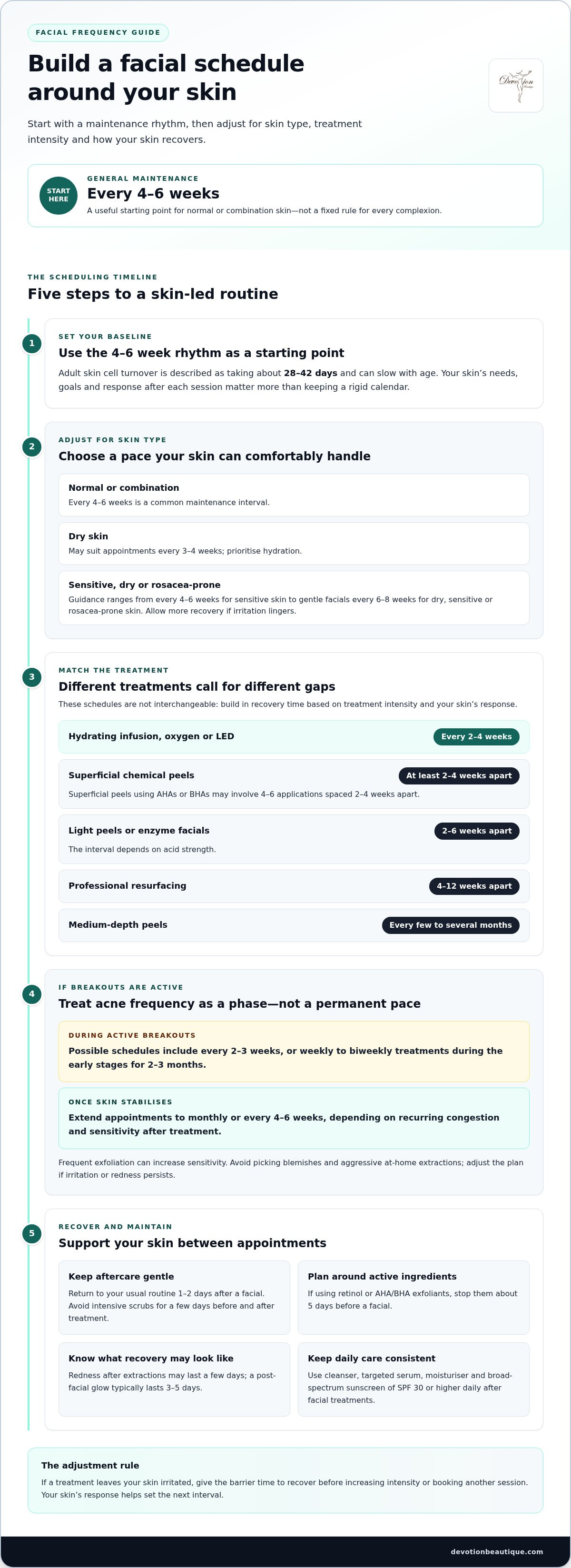
A useful routine supports your skin between appointments, not just during them. General maintenance facials are commonly scheduled every 4-6 weeks, but that interval is a starting point. Adult skin cell turnover is described as taking about 28-42 days, and it can slow with age. That change may contribute to dullness and congestion. The answer to how often you should get a professional facial depends on your skin type, treatment goals and how your skin responds after each session.
Skin type helps shape a comfortable schedule. For normal or combination skin, a facial every four to six weeks is a typical maintenance interval. Dry skin may suit appointments every 3-4 weeks, while sensitive skin may benefit from every 4-6 weeks. If your skin is dry, sensitive or rosacea-prone, gentler facials may be more appropriate. These ranges reflect different needs: consider whether hydration, calming or congestion is the main concern. If a treatment leaves your skin irritated, allow the barrier to recover before increasing its intensity.
Treatment intensity also matters. Hydrating infusion, oxygen or LED treatments may be scheduled every 2-4 weeks for ongoing benefits. Superficial chemical peels are spaced at least 2-4 weeks apart, while professional resurfacing treatments may be spaced 4-12 weeks apart. These are not interchangeable schedules. A more intensive treatment needs a longer recovery interval, and combining active treatments can increase irritation. Build the calendar around the treatment itself, rather than assuming every facial uses the same approach.
Acne-prone skin may need closer attention during active breakouts, but frequent exfoliation can leave skin feeling more sensitive. Active acne care may use weekly to biweekly treatments during the early stages for 2-3 months, then monthly maintenance. Other guidance suggests appointments every two to three weeks during active breakouts, extending to every four to six weeks once skin stabilises. Professional cleansing can reach deeper than consumer-grade scrubs, while trained extractions are intended to avoid damaging the lipid barrier. At home, skip picking and aggressive extractions.
For anti-ageing or textured skin, a four- to six-week facial routine may support ongoing care. Mature skin may suit intervals of 3-6 weeks, depending on treatment intensity. A professional treatment plan can address concerns such as uneven texture, while home care maintains consistency between visits. Keep the daily routine simple: cleanser, targeted serum, moisturiser and sunscreen. If using retinol or AHA or BHA exfoliants, stop them about five days before a facial. Daily sunscreen helps protect skin between appointments, especially when exfoliating treatments are part of your routine.
Facial frequency for acne-prone or congested skin
For acne-prone skin, appointment frequency can change as breakouts settle. During active breakouts, facials may be scheduled every two to three weeks. Another approach uses weekly to biweekly treatments during the early stages for 2-3 months, followed by monthly maintenance. These are possible schedules, not a reason to increase exfoliation whenever a blemish appears. Track how your skin responds after each visit, including persistent irritation or redness, and adjust the plan accordingly.
Once breakouts are controlled, extend the interval rather than continuing intensive appointments by default. Guidance ranges from once a month to every four to six weeks after skin stabilises. The right timing depends on recurring congestion, sensitivity after treatment and the level of exfoliation involved. A closer schedule may suit ongoing concerns, while calmer skin may need less frequent treatment. Keep home care consistent so you can notice changes between appointments.
Sensitive or reactive skin needs a different balance. Gentle facials are suggested every 6-8 weeks for dry, sensitive or rosacea-prone skin, while another recommendation places sensitive skin at every 4-6 weeks. These ranges can accommodate different levels of reactivity and treatment intensity. If redness or irritation lingers after exfoliation, choose a gentler approach and allow more recovery time before the next appointment. For reactive skin, barrier support and hydration matter more than frequent aggressive exfoliation.
For normal or combination skin, a facial every four to six weeks is a common maintenance rhythm. Monthly appointments offer a simple routine, but they aren’t compulsory if your skin remains comfortable between visits. Consider the balance of oily and dry areas, seasonal changes and the concern you want to address. For example, congestion around the nose may call for targeted care, while dry cheeks may respond better to hydration than stronger exfoliation.
Chemical peels require a schedule based on peel depth and formulation. Light chemical peels or enzyme facials may be spaced 2-6 weeks apart, depending on acid strength. Superficial chemical peels generally use alpha-hydroxy acids or beta-hydroxy acids, with 4 to 6 applications spaced 2 to 4 weeks apart. Medium-depth peels may be performed every few to several months. Redness or irritation after treatment is a reason to prioritise recovery rather than add another exfoliating session.
When targeted correction is the goal, a Remedial Facial may fit into a considered routine. Match the appointment interval to the treatment’s intensity and your skin’s response, especially if acne care and chemical peels are both part of your plan.
Aftercare and scheduling follow-up appointments
Aftercare and appointment timing go hand in hand: follow your post-facial plan, then schedule your next visit around your skin’s recovery and goals.
Aftercare Between Appointments
Aftercare helps your skin settle after treatment and supports your routine between visits. Extractions may leave redness for a few days, while a post-facial glow typically lasts three to five days. Keep your skin comfortable during this period: avoid intensive scrubs for a few days before and after your facial, and don’t pick at blemishes.
Return to your usual skincare routine one to two days after a facial. Until then, keep steps simple and avoid adding new exfoliants that could increase irritation. Use broad-spectrum sunscreen of SPF 30 or higher daily after facial treatments. If you’re addressing dark spots or uneven texture, consistent sun protection helps protect your skin while your longer-term routine continues.
Plan appointments around important events, too. Book a facial seven to ten days beforehand to give possible redness or purging time to settle. After extractions, redness can last a few days. If an event is close, there may be little time for a temporary reaction to fade, so choose a familiar, gentle treatment rather than adding new steps at the last minute.
Time Between Appointments
The interval between appointments gives your skin time to recover and lets you maintain your routine before your next facial. For general maintenance, four to six weeks is a practical reference. It gives you time to observe changes in hydration, texture and congestion before choosing another treatment. The ideal follow-up date also depends on whether your previous appointment focused on calming, exfoliation or a more intensive concern.
Use the weeks between visits to notice patterns, not just immediate changes. Record when dryness, congestion or irritation appears, and share those observations at your next appointment. If your goals include improving texture, dark spots or age-related concerns such as collagen support, track progress under similar lighting. This makes gradual changes easier to compare than relying on how your skin looked immediately after a facial.
If time or budget limits appointments, treatments may be spaced every 2-3 months alongside consistent home care. Keep daily cleansing, moisturiser and sunscreen in your routine between visits. After a facial, follow the recommended aftercare and resume your normal routine one to two days later. That steady rhythm helps you decide whether the next appointment should maintain comfort or address a changing skin concern.
At-home skincare between facials
A facial is one part of skincare; your daily routine helps maintain hydration and a comfortable appearance between appointments. Keep the basics consistent: cleanser, a targeted serum, moisturiser and sunscreen. For example, choose a serum for your main concern, such as dullness or fine lines, rather than layering several new active products at once. A steady routine makes it easier to notice what your skin tolerates.
Use cleanser to remove the day’s residue, then apply serum and moisturiser to support hydration. Finish with broad-spectrum sunscreen of SPF 30 or higher each day. Sun protection matters after facial treatments and supports care for dark spots and uneven appearance. Reapply according to the product directions, especially after time outdoors. A simple routine is easier to maintain than a shelf full of overlapping products.
Keep at-home exfoliation measured between professional treatments. One general recommendation is to exfoliate about once a week, but that may not suit every skin type. If your face feels tight, stings or looks persistently red, pause exfoliation and focus on gentle cleansing and moisturiser. Avoid combining a scrub with several active products in the same routine. More friction does not automatically mean smoother texture.
Masks can add a focused step, but choose them according to your skin’s response. Sheet masks may be used once a week, while clay masks may be used once or twice weekly. Activated charcoal and tea masks are suggested once a month, and gelatin masks twice a month. These are examples, not a reason to use every mask type. If you have sensitive skin, introduce one product at a time and stop if irritation develops.
Patch-test a homemade mask before applying it across your face. If irritation appears within 24 hours, don’t use that mixture on your face. This small test helps you avoid turning an experiment into widespread redness or discomfort. Keep ingredients and timing simple, and avoid applying a new mask immediately after strong exfoliation or a facial treatment.
Between appointments, track changes rather than chasing an instant glow. Note whether hydration, dullness, fine lines or congestion shift after introducing a product. Change one step at a time, then observe your skin’s response. If you use retinol or AHA or BHA exfoliants, stop them about five days before a facial. Avoid picking blemishes or aggressive at-home extractions, which can aggravate irritation and disturb the skin barrier. A steady routine gives your next appointment a clearer picture of your skin’s needs.
When should you avoid a facial or consult a dermatologist first?
Pause facial treatments after irritation, an allergic reaction or a procedure, and wait until your skin is fully healed. Adding cleansing, exfoliation or extractions while your skin is unsettled can complicate your routine. If a product has caused a reaction, stop using it and note the product and when symptoms began. Share those details when seeking guidance.
“Fully healed” is the point to consider before booking again, not simply the day redness becomes less noticeable. Check whether the irritation has settled and whether your usual skincare causes discomfort. If your skin still feels reactive, postpone the appointment. A fresh reaction after trying a new serum, for example, is a reason to pause rather than add another treatment.
A recent procedure also affects your decision. Wait until your skin is fully healed rather than using your usual facial date as the deciding factor. Follow the recovery guidance for the procedure and avoid adding a facial while healing continues. If you’re unsure whether recovery is complete, consult a dermatologist before scheduling treatment.
Consider a dermatologist if a skin concern is persistent, recurring or difficult to distinguish from a product reaction. For example, repeated redness after using different skincare products deserves attention before exfoliation or extractions. A facial addresses cosmetic care, while a dermatologist can assess an ongoing skin concern. Keep a simple record of products used, when the concern appeared and what changed. Those details make the conversation more specific.
Before your next appointment, review your skin’s recent history. List any reaction, procedure or new product, then note whether symptoms have fully settled. Mention active irritation or a recent allergic reaction before treatment begins. This gives the professional a clearer picture and helps avoid an unsuitable appointment. Don’t conceal redness or discomfort because you’re worried about postponing.
Once your skin has healed, return gradually instead of combining several strong steps at once. Keep your first routine simple: cleanser, moisturiser and sunscreen, then reintroduce other products according to your skin’s response. If discomfort returns, stop the new step and seek dermatological guidance before booking another facial. This measured approach can help distinguish a product reaction from the effects of treatment.
Skin that is calm and fully healed can return to a considered facial routine. For support choosing an approach that fits your skin concerns, explore personalised facial care.
Devotion Beautique: Advanced Aesthetic Series Skin Boosting RETREAT
Devotion Beautique’s Advanced Aesthetic Series Skin Boosting RETREAT offers skincare support shaped around your complexion. For targeted concerns, the ReProgram Facial and Remedial Facial provide options within its facial programmes, while the Relaxation Facial offers a gentler, restorative focus.
Choose based on what you want to address, whether that’s hydration, calming, brightening, firming or repair. A personalised treatment programme can help connect your appointment schedule with your skin goals and home routine. If you’re ready to explore an approach tailored to your complexion, contact Devotion Beautique.
Make Your Facial Routine a Thoughtful Practice
Your skin’s needs can shift with stress, weather, products and changing priorities. Treat your routine as something to observe and refine, rather than a fixed calendar. Note what feels comfortable, what triggers irritation and which concerns remain. These details can help shape a more considered conversation about your next appointment.
If you’re still deciding how often you should get a professional facial, focus on a schedule that suits your skin’s response and everyday care. Devotion Beautique offers personalised facial programmes, from restorative care to targeted support. Share your skin goals with the team and discuss a routine that feels manageable.
Contact Devotion Beautique to plan your facial, and take the next step toward skin care that feels more intentional and personal.
Frequently Asked Questions
The Power of Maintenance: How Often Should You Get a Professional Facial?
For routine maintenance, a professional facial every 4-6 weeks is a common starting rhythm. The interval gives you a chance to assess how your skin looks and feels before booking again. If your complexion stays comfortable and your main goal is upkeep, maintain that cadence; if dryness, congestion or sensitivity changes, adjust the next visit rather than treating the calendar as a rule.
How often should you get a professional facial based on skin type and concerns?
Skin type and the concern being addressed both shape your schedule. Normal or combination skin commonly follows a four-to-six-week routine, while dry skin may suit a three-to-four-week interval. Sensitive skin may need gentler treatment and more recovery time. For example, if exfoliation leaves your cheeks uncomfortable, prioritise calming care instead of shortening the gap between appointments.
What is the recommended time between professional facials?
For general maintenance, allow 4-6 weeks between facials as a useful reference. The treatment itself can change that timing: hydrating or calming care differs from a peel or resurfacing session. Consider how your skin responded after the last appointment, including lingering redness or irritation, before scheduling another. The interval should leave room for recovery, rather than being chosen solely for convenience.
How often should people with acne get professional facials?
During active breakouts, acne-prone skin may benefit from appointments every two to three weeks. Some early-stage plans use weekly to biweekly treatments for 2-3 months, followed by monthly maintenance. Once breakouts settle, appointments may move to every four to six weeks. If extractions or exfoliation leave your skin irritated, avoid adding treatments simply to follow a tighter schedule.
How often should sensitive or rosacea-prone skin get a facial?
For dry, sensitive or rosacea-prone skin, gentle facials are suggested every 6-8 weeks. Another general interval for sensitive skin is 4-6 weeks, so the treatment’s gentleness and your skin’s reaction matter. For instance, if cleansing products sting after an appointment, extend recovery time and focus on calming, hydrating care before booking another exfoliating treatment.
How often are anti-ageing or hydrating facials recommended?
Hydrating infusion, oxygen and LED treatments may be scheduled every 2-4 weeks for ongoing benefits. For mature skin or an anti-ageing focus, facials may be spaced 3-6 weeks apart, depending on treatment intensity. Choose the interval according to the treatment and how your skin recovers. A gentle hydration session and an intensive resurfacing treatment shouldn’t automatically share the same schedule.
What factors affect how frequently you should get a facial?
Frequency depends on your skin type, the concern you’re addressing, treatment intensity and your response afterward. A plan for active congestion may differ from one focused on hydration or texture. Home products matter, too: retinol and AHA or BHA exfoliants can affect skin sensitivity around an appointment. Note any dryness, redness or irritation after treatment, then use those observations to guide future scheduling.
What are the risks of getting facials too often?
Scheduling treatments too close together can leave skin irritated, red or uncomfortable, particularly when appointments involve exfoliation or extractions. Aggressive at-home extraction can also disturb the skin’s lipid barrier. If your skin remains tender or reacts to routine products after a facial, pause further treatments until it has healed. A shorter interval isn’t automatically better: let recovery and treatment intensity guide your next appointment.
