
Signs of a Good Esthetician in Personalized Skin Care
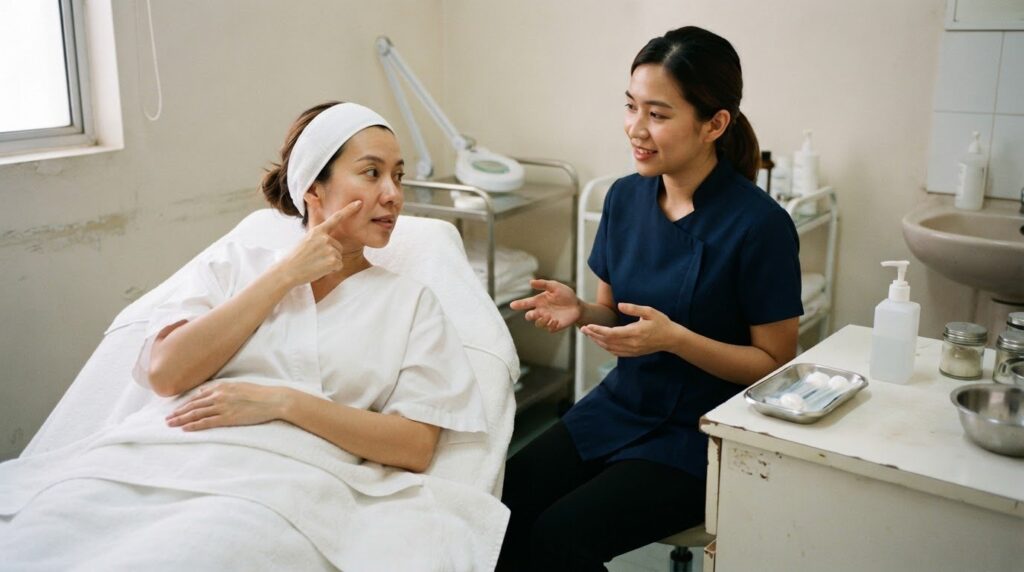
A facial should never feel like a routine being performed on your skin. The clearest signs of a good esthetician include asking about your skin history, answering your concerns clearly, maintaining clean tools, and tailoring the treatment to your needs. Your comfort and preferences should shape the experience, not come as an afterthought.
Look beyond a soothing room or an appealing treatment menu. Trust grows when a skincare professional listens, explains recommendations in language you understand, and adapts the approach to your skin’s condition and goals. This guide covers what to notice before and during an appointment, from questions about products, allergies, and medications to clean tools and thoughtful treatment choices. You’ll also learn how personalised care can support a considered routine and help you choose an experience that respects your needs.
Key Takeaways
- Look for an esthetician who explains recommendations clearly and takes your questions and preferences seriously.
- Share your current skincare routine, allergies, medications, and concerns so treatment choices can be informed by your skin history.
- Notice whether tools, towels, products, and treatment spaces appear clean and well cared for.
- Choose care that adapts to your skin’s condition and goals rather than following a one-size-fits-all routine.
- Use the consultation to understand how a facial fits into your broader skincare approach and what habits may support care between visits.
1. Esthetician knowledge and answering client questions
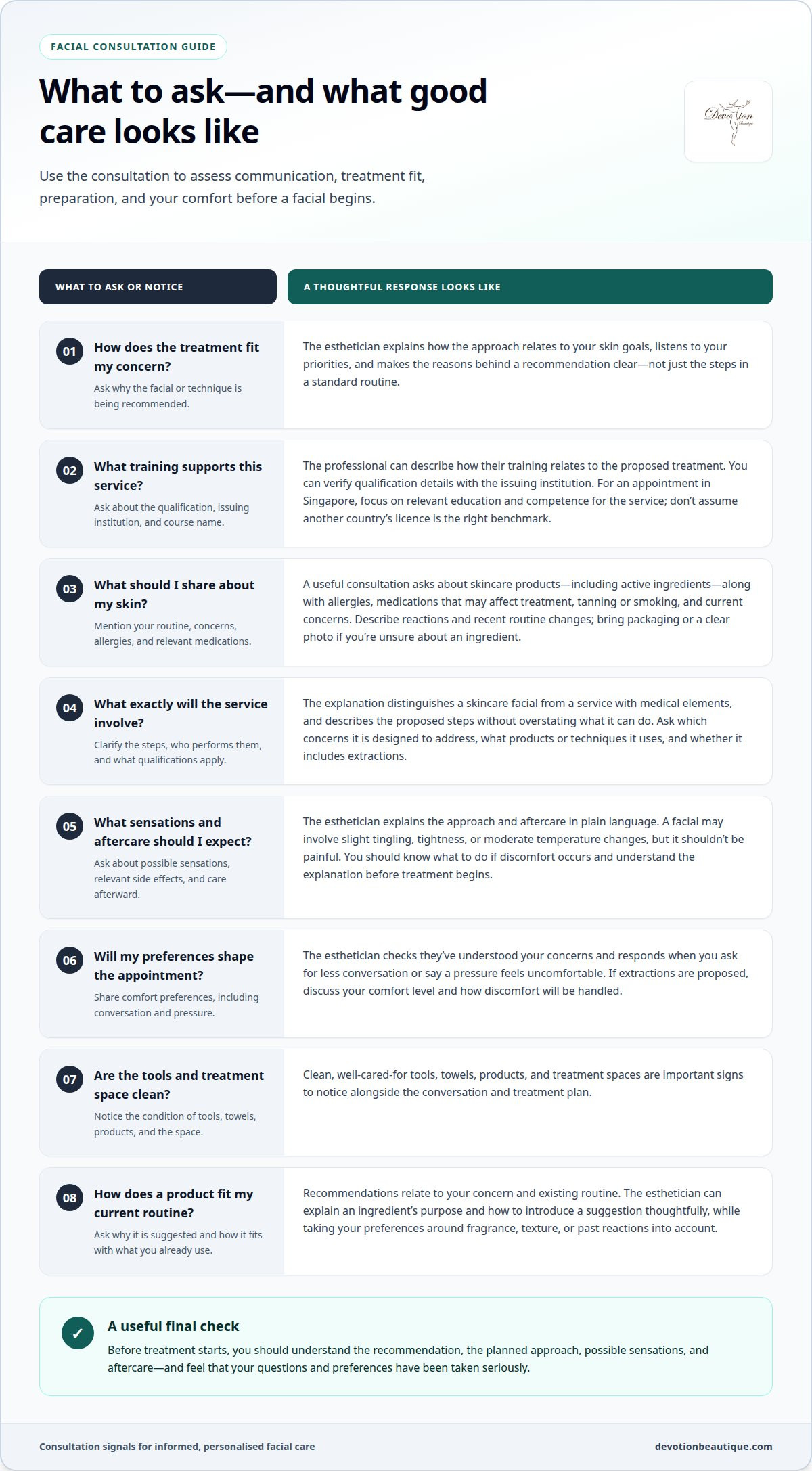
A knowledgeable esthetician can explain why a facial suits a particular concern, not just describe its steps. Ask what an ingredient is intended to do and how it relates to your skin goals. A clear answer uses familiar language, such as explaining why a gentler approach may suit skin that feels easily irritated. The professional should welcome follow-up questions instead of rushing you towards a decision.
Listening matters just as much. If you mention tightness after cleansing, discomfort with fragrance, or stress affecting your routine, those details should inform the conversation. Notice whether the esthetician checks they’ve understood your concern before recommending a service. Small preferences matter too: if you ask for less conversation or say a certain pressure feels uncomfortable, the professional should respond and adjust.
When comparing estheticians, look for reviews that give specific details about communication, attentiveness, and whether recommendations felt personalised. Referrals can add context, but someone else’s skin and preferences may differ from yours. Compare those accounts with your consultation: did the esthetician listen, answer clearly, and explain a practical next step? Those observations are more useful than praise focused only on the room or atmosphere.
For a Singapore appointment, look for relevant skincare education and demonstrated competence in the treatment being discussed. Ask what training supports that service and what its scope involves; a professional title alone doesn’t explain either. Don’t assume a licence issued under another country’s rules is the appropriate benchmark for Singapore. Focus on whether the person can describe their training and explain how it relates to your requested treatment.
To understand an esthetician’s credentials and training, ask about their qualification, the issuing institution, and the course name. You can verify those details with the institution that issued the document. Ask how the training relates to the proposed technique, especially for a specialised procedure. A careful, straightforward explanation helps you judge whether the esthetician’s preparation matches the service.
Before treatment, the esthetician should explain the approach, possible sensations, relevant side effects, and aftercare in plain language. A facial may involve slight tingling, tightness, or moderate temperature changes, but it shouldn’t be painful. Ask what to do if discomfort occurs and which aftercare steps matter, such as following the recommended routine. Make sure you understand the explanation before treatment begins.
Knowledge should lead to considered care, not a standard script. Someone seeking help with dullness may need a different discussion from someone whose skin feels stressed and sensitive. A good esthetician explains the options, listens to your priorities, and makes the reasons behind a recommendation clear. These signs of a good esthetician help you assess both expertise and the quality of care.
2. Asking about skin concerns, products, allergies, and medications
A useful consultation starts with details that can affect how a facial is planned. Expect questions about your concerns, skincare products, allergies, medications, tanning, and smoking. Mention what you apply at home, including active ingredients, and when you last used them. If you’re unsure what a product contains, bring the packaging or a clear photo of its ingredient list.
In Singapore, the relevant requirements depend on the service being performed, so distinguish a skincare facial from a procedure with medical elements. Ask what the treatment involves, who will perform it, and what qualifications apply to that specific service. The treatment’s label alone may not explain its scope. A clear response should describe the proposed steps without overstating what the service can do.
Before booking, ask which concerns the treatment is designed to address, what products or techniques it uses, and how your routine affects its suitability. Also ask what sensations to expect, what aftercare involves, and whether the facial includes extractions. If extractions are proposed, discuss your comfort level first and ask how the esthetician will respond if you feel discomfort. You should be able to make an informed choice about each step.
Product recommendations should relate to your concern and existing routine. If you already use a cleanser and moisturiser, ask how a suggested product fits alongside them instead of accepting a generic list. A knowledgeable esthetician can explain an ingredient’s purpose and how to introduce a recommendation thoughtfully. Mention if fragrance, texture, or a previous reaction affects what you’re willing to use.
Skincare specialists may provide facials, recommend products, and offer related services such as makeup application. Career paths can also include makeup artistry, waxing, teaching, product ambassadorship, or spa management. These roles differ, so ask about training that relates directly to the treatment you’re considering. A broad beauty background doesn’t replace a clear explanation of the specific service.
Keep your answers specific. “Sensitive skin” is a start, but examples help: describe when irritation occurs, which products you used, and what happened afterward. Mention prescription or over-the-counter medications that may affect treatment rather than deciding they’re irrelevant. These details help the esthetician understand your skin history and make a considered recommendation. If something changes between booking and your appointment, share the update before treatment begins.
The consultation should be a two-way conversation. Before a facial, an esthetician should ask about your skincare products, allergies, medications that may affect treatment, tanning or smoking, and current skin concerns. Clarify which products you use regularly and mention recent changes, so the discussion reflects your routine rather than assumptions.
Estheticians learn about skincare products and ingredients, including how ingredients may react when applied to skin. Ask them to explain any suggested ingredient in relation to the products you already use. Since estheticians may recommend skincare products, ask why a recommendation suits your concern and how it fits your routine. If the explanation leaves you uncertain, ask for clarification before deciding whether to add it.
3. Checking spa cleanliness and sanitation
Before a facial, look beyond the treatment bed. Check whether floors, walls, ceilings, tools, products, towels, and bathrobes appear clean and well maintained. These details offer practical clues about how carefully the workspace is managed. A fresh towel and an orderly trolley, for example, help you see what will touch your skin before treatment begins.
Pay close attention to the tools. Reusable equipment should be cleaned and sterilised between clients, and the esthetician should be able to explain how it is prepared. Notice whether tools are stored in a clean area rather than left beside used towels or opened products. If the process is unclear, ask what happens to each reusable item after a facial.
Sanitation supports infection control because unsanitary spa conditions can potentially spread bacteria and make treatment unsafe. Watch the sequence: the practitioner should prepare the space and tools before starting, then keep used items separate from clean ones. If an item falls or touches an unclean surface, it should not go straight back onto your skin.
Warning signs include visibly dirty tools, stained towels, products left open or exposed to debris, and a neglected workspace. A practitioner who dismisses a reasonable question about equipment cleaning or continues using a dropped tool gives you reason to pause the appointment. These observations matter more than polished décor or a calming fragrance.
Assess the treatment area as a whole. Check the floor around the bed, the surfaces holding products, and the condition of towels and bathrobes. Notice whether used materials are kept apart from clean supplies. A tidy room doesn’t prove that every sanitation step is followed, but visible cleanliness helps you assess how thoughtfully the space is maintained.
Before treatment begins, make a simple check: observe the room, look at the tools and linens, then ask how reusable equipment is sterilised. Listen for a clear, direct explanation of the actual process. The answer should explain how clean tools are kept separate and prepared for use, rather than rely on vague assurances.
Noticing these details helps you make a calm, informed decision. If a clean towel is replaced after becoming damp or a tool is set aside after touching an unclean surface, those actions show attention to the treatment environment. Choose an appointment where visible cleanliness and careful handling support your comfort from preparation through the facial.
4. Beauty and skincare knowledge
Strong skincare knowledge goes beyond memorising product names. An esthetician should explain how an ingredient relates to a concern, such as hydration or sensitivity, and how it fits into a facial. They should also understand that ingredients can affect skin differently. Ask for the reasoning behind a recommendation, not just its advertised benefit.
Beauty education can include cosmetic chemistry, anatomy, and biology. These subjects help a professional explain how a product’s ingredients and a treatment technique relate to skin. An esthetician, for example, should be able to explain why they selected a particular approach for your concern. Clear explanations show how knowledge informs the service.
Some estheticians also study aromatherapy and psychodermatology, which connects skin and psychological wellbeing. That broader perspective can help them discuss how relaxation fits into a facial experience without presenting it as a substitute for skincare. A professional should distinguish a calming ritual from a targeted treatment and explain what each is intended to do.
The beauty industry evolves, so learning should continue beyond initial training. New techniques and trends give professionals fresh material to assess, but an informed esthetician won’t recommend something simply because it’s popular. Ask what a technique is intended to address and how it fits your skin goals. The answer should connect the method to your needs.
Knowledge also shows in practical preparation. Estheticians may balance pH when preparing facials and should explain the purpose of the products or steps they choose. If you feel slight tingling, tightness, or a moderate temperature change, tell them what you’re experiencing. A facial shouldn’t be painful, and your feedback should guide the next step.
Good skincare advice extends beyond the treatment room. An esthetician should be able to suggest an at-home routine that supports care between facial visits. Ask, for example, how to use a recommended product alongside your existing cleanser and moisturiser. Specific, manageable guidance is more useful than a long list of products without a clear purpose.
Notice how the professional adapts their explanations to you. If you ask what a product does, they should describe its role in plain language and connect it to your concern. They should also explain when a recommendation doesn’t fit your priorities. These exchanges reveal whether skincare knowledge is being applied thoughtfully rather than delivered as a prepared script.
Use a simple check during your consultation: name a skin goal, ask why the proposed approach suits it, then ask what care continues at home. A good esthetician can connect those steps into a coherent plan. That combination of scientific understanding and practical guidance supports more informed skincare choices over time.
5. Customising treatments to individual skin needs
A facial should respond to your skin’s current condition, not follow the same script at every appointment. Start with one clear goal, such as improving the feel of dryness or calming skin that feels easily unsettled. The esthetician can then explain which parts of the treatment relate to that goal. If the plan sounds unchanged regardless of your answers, ask how it accounts for your needs.
Personalisation should shape more than product selection. It can influence the treatment’s focus, the sequence of steps, and how the professional responds to your comfort. If you prefer a quieter appointment, for example, that preference can guide the atmosphere. If a product’s texture or scent concerns you, discuss it before application. Tailored care makes room for practical preferences as well as skincare priorities.
Skin needs can vary across areas of the face. You might describe dryness around your cheeks while another area seems to need a different focus. Share those observations rather than relying only on a broad label such as “combination skin.” Ask the esthetician to explain how the treatment will address each concern and which steps support your main goal.
A considered recommendation should connect three things: your concern, the treatment approach, and the care you can maintain at home. If hydration is your priority, for instance, ask how the facial supports that focus and what routine guidance follows. The explanation should be understandable and relevant to the products you already use. A personalised plan needn’t be complicated; each recommendation should have a clear purpose.
Use the consultation to find out whether the plan can adapt. Explain what you hope to address, mention preferences that affect your comfort, and ask what the treatment involves. If your skin feels different on the day, raise that before the facial begins. The professional should use this information to discuss an appropriate approach, rather than treating the original plan as fixed.
Customisation also means matching the service to the area and concern being discussed. For an underarm concern, for example, a facial would not address the treatment area. Devotion Beautique’s Underarm Bleaching Advanced Treatment is the relevant offering to explore for that specific concern. For facial goals, use the consultation to clarify what you want addressed and how the recommended facial’s focus relates to it.
A facial should respond to the concerns you raised, not follow a standard, one-size-fits-all routine. The discussion should stay focused on your needs.
Devotion Beautique: Advanced Aesthetic Series Skin Boosting RETREAT
Devotion Beautique’s Advanced Aesthetic Series Skin Boosting RETREAT is a next step for those seeking facial care shaped around their skin goals. Its personalised approach can address needs such as hydration, brightening, firming, calming, repair, or age-support, helping you explore a treatment focus that reflects your concerns.
If you’re considering a facial for targeted correction or longer-term skin improvement, the ReProgram Facial or Remedial Facial may also suit your needs. The right fit depends on the concerns you want to address and the kind of care you’re seeking. Discuss those priorities in your consultation and ask how the treatment approach relates to them.
For a considered conversation about your skin goals and suitable facial care, contact Devotion Beautique.
Make Your Next Skin-Care Choice With Confidence
Your skincare priorities may evolve as your skin changes. Treat each appointment as a chance to understand what feels comfortable, what suits your routine, and which goals matter most to you. The signs of a good esthetician include care that leaves room for questions and helps you make considered choices, rather than pressuring you to pursue every treatment.
If you’re ready to explore personalised care, consider which concern you’d like to discuss first. Devotion Beautique offers the Advanced Aesthetic Series Skin Boosting RETREAT, Underarm Bleaching Advanced Treatment, and ReProgram Facial. Let your priorities guide the conversation as you decide on a meaningful next step for your skincare journey.
Contact Devotion Beautique to begin a thoughtful conversation about your skincare goals. Take the next step at your own pace, with your needs at the centre.
Frequently Asked Questions
What makes a good esthetician?
A good esthetician combines skincare knowledge with attentive, respectful care. They explain the reasoning behind recommendations, welcome your questions, and adapt their approach to your goals and comfort. The signs of a good esthetician also include honest communication: you should understand what a treatment is intended to do and what it involves before deciding. Notice whether the professional listens to your priorities instead of steering the conversation towards unrelated services.
What hygiene and sanitation standards should a reputable esthetician follow?
A reputable esthetician should work in a clean treatment area with properly prepared equipment. Before starting, notice whether fresh linens are used and tools are kept apart from used items. If an instrument touches the floor, for example, it should be set aside rather than returned to the treatment area. You can ask how reusable equipment is cleaned and sterilised; a clear explanation helps you understand the process.
How should a good esthetician assess skin type and customize treatments?
A good esthetician should consider your skin’s current condition, concerns, and preferences before choosing a treatment. Describe how your skin behaves in different situations, such as feeling tight after cleansing or becoming uncomfortable with a particular texture. The esthetician can use those details to explain the treatment’s focus and adapt its approach. A useful recommendation connects your goal with a practical plan you understand.
What qualifications and licenses should a good esthetician in Singapore have?
Look for relevant skincare education and demonstrated competence in the treatment, and ask what training supports it. Requirements depend on the service, especially if it has medical elements; verify the qualification with its issuing institution rather than relying on a professional title or a licence from another country.
